
What a travel itinerary from notes needs to contain
A useful itinerary lets someone understand the next day without searching the entire source collection. It needs dates, a starting point, the day's main commitments, and enough practical context to find the right source when something changes.
Collect these fields before writing a polished version:
| Field | What to record | Keep uncertainty visible |
|---|---|---|
| Trip frame | Destination, dates, travelers, preferred pace | Mark dates that are still flexible |
| Fixed arrangements | Confirmed travel, accommodation, timed activities | Link to the original confirmation |
| Candidate places | Name, area, why you saved it | A saved place is not a reservation |
| Constraints | Arrival and departure windows, interests, spending limits | Record whose constraint it is |
| Open questions | Missing hours, transport details, undecided choices | Name the source or person that can resolve each one |
Use local dates and times consistently. When a journey crosses time zones, preserve the zone shown on the original booking. A readable summary should still let you trace a time back to its source.
If the group has not agreed on dates, pace, or shared spending, start with a group trip planning brief. Resolve those choices before turning a wish list into a full schedule.
Separate fixed plans from possibilities
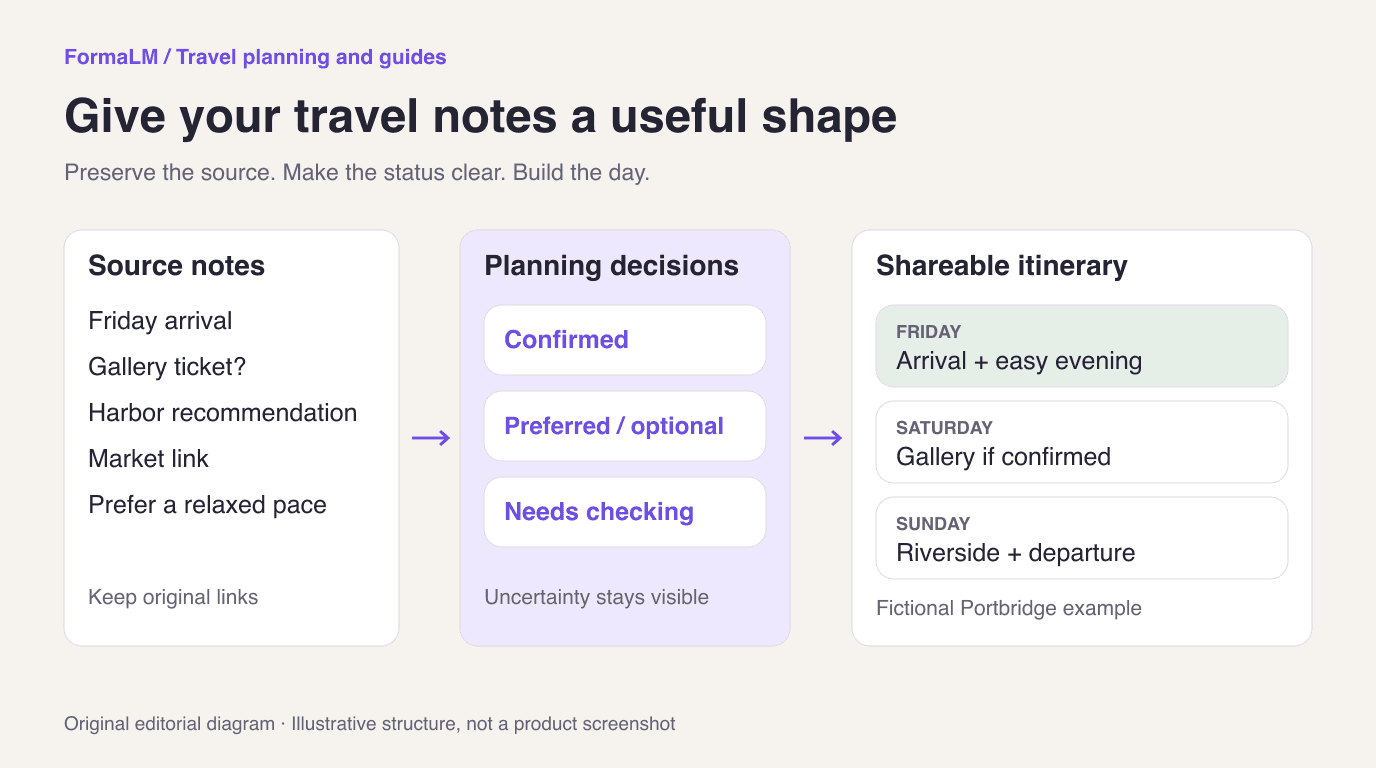
Give every source note one status: confirmed, preferred, optional, or needs checking. That small decision prevents a draft from quietly turning a suggestion into a commitment.
“Museum on Saturday?” is a candidate. “Timed ticket for Saturday at 11:00” is a fixed arrangement only when you have checked the confirmation. Keep the question mark until the source supports removing it.
Use one row per item:
| Source note | Status | Scheduling consequence | Source to retain |
|---|---|---|---|
| Arrive Friday afternoon | Confirmed if booked | Keep the first afternoon light | Travel confirmation |
| Friend recommends the riverside market | Preferred | Consider it near other riverside stops | Friend's note or saved link |
| One long museum visit | Optional | Choose a day with room for it | Official visitor information |
| Restaurant may close early | Needs checking | Avoid treating dinner as settled | Restaurant's own current information |
These are planning examples, not statements about a real destination. For your trip, verify changing details with the operator, venue, accommodation, or transport provider. Keep booking references and personal contact details in the private source record when they are unnecessary for the people receiving the shared plan.
Group the notes by day and area
Start with the fixed arrangements. Add nearby candidates around them, allowing for transfers, meals, and the pace you want. Treat an AI-generated sequence as a draft to check against current routes and timings.
For each day, choose a main purpose such as arrival, one neighborhood, a reserved activity, or a day with more flexibility. Add a few relevant possibilities and keep the rest in a separate shortlist. A place can remain worth visiting without being assigned to this trip.
Ask four practical questions as you arrange the notes:
- Where does the day start and finish?
- Which times are fixed by an actual arrangement?
- Which activities can move or be dropped?
- What must be checked before anyone relies on this sequence?
If the day only works when every transfer is immediate, remove an activity or leave a wider gap. Show an alternative as an alternative, with a clear condition for choosing it. Do not place two competing plans in the same time slot without explaining the choice.
A worked notes-to-itinerary example
The following three-day trip to Portbridge, a fictional city, is an invented editorial example. It is not a customer trip, a FormaLM generation result, or a source of current travel recommendations.
The rough material reads:
> Friday arrival around 15:00. Staying near the central station. Sam wants the harbor. Saturday gallery ticket says 11:00, check the email. Sunday train at 16:00. Riverside market sounds good. Leave time for long lunches. Bakery link from Rin. Maybe the hill walk, unless it makes the weekend too busy.
First, identify what changes the schedule. The two travel windows define the edges of the weekend. The gallery time requires checking. The harbor and long lunches express preferences. The bakery and market need current details. The hill walk is optional.
| Day | Main plan | Flexible choice | Check before sharing |
|---|---|---|---|
| Friday | Arrival, accommodation, an easy evening near the station | Bakery if its location and hours fit | Arrival time, check-in details, bakery information |
| Saturday | Gallery at 11:00 if the ticket confirms it; unhurried lunch | Harbor later in the day | Ticket date, local transfer time, gallery location |
| Sunday | A short riverside visit, then return for departure | Market if it operates that day | Market information, luggage plan, train details |
The hill walk stays in the shortlist. It has not been forgotten; it would compete with the pace the travelers requested. If the gallery ticket turns out to be for Sunday, move the anchor and reconsider both days instead of merely changing a date in the finished text.
The shared version can now explain the trip in a few lines per day. The private source list retains the confirmations, original links, and questions that still need answers. That separation makes the itinerary easier to read without losing the evidence behind it.
Choose a web page or carousel
Use a web page when the reader needs a plan they can scan by day, reopen, and check alongside source links. A carousel suits a short overview where each card has one clear job. Detailed confirmations should remain accessible in their original form.
| Reader's next action | Useful format | What to include |
|---|---|---|
| Follow the plan during the trip | Web page | Dates, sequence, fixed arrangements, source links |
| Review the outline before agreeing | Short page or carousel | Trip frame, daily shape, choices still open |
| Reuse your recommendations for another visit | Travel guide | Who it suits, selected places, practical observations |
For that last task, use the separate method for making a travel guide from notes. A guide needs to explain why a place belongs and who might enjoy it; it does not need to preserve your exact departure time or booking details.
Build the draft in FormaLM
The Trip planner template starts with Destination and Trip details. In Trip details, include your dates, fixed arrangements, interests, pace, and unresolved choices. Label the status of each item in your own material so the distinction can survive into the draft.
For the fictional example, the input could say:
> Portbridge, a fictional city, Friday to Sunday. Arrival Friday around 15:00, departure Sunday at 16:00. Accommodation near the central station. Prefer a relaxed pace and long lunches. Gallery booking may be Saturday at 11:00; keep it marked unconfirmed until I check. Harbor preferred; hill walk optional. Do not invent opening hours or travel times.
Choose a web page or carousel for the result, then review the generated content against the source notes. FormaLM provides a guided creation workflow; you still need to verify current logistics. This article does not establish automatic reservation imports, live routing, group editing, or booking functionality.
Review the plan before sharing
Read the draft as someone who has never seen your notes. Can they find the correct day, distinguish a commitment from an idea, and see what is still undecided?
Check each fixed time against its confirmation. Check venue and transport details with current sources. Remove private references that the recipient does not need. Make the publication or check date visible when sharing practical information that can change.
Finally, test one interruption: imagine an activity becomes unavailable. The plan should show which part can move, what remains fixed, and where to find the original details. When those distinctions are clear, your travel notes have become a plan someone else can use.