
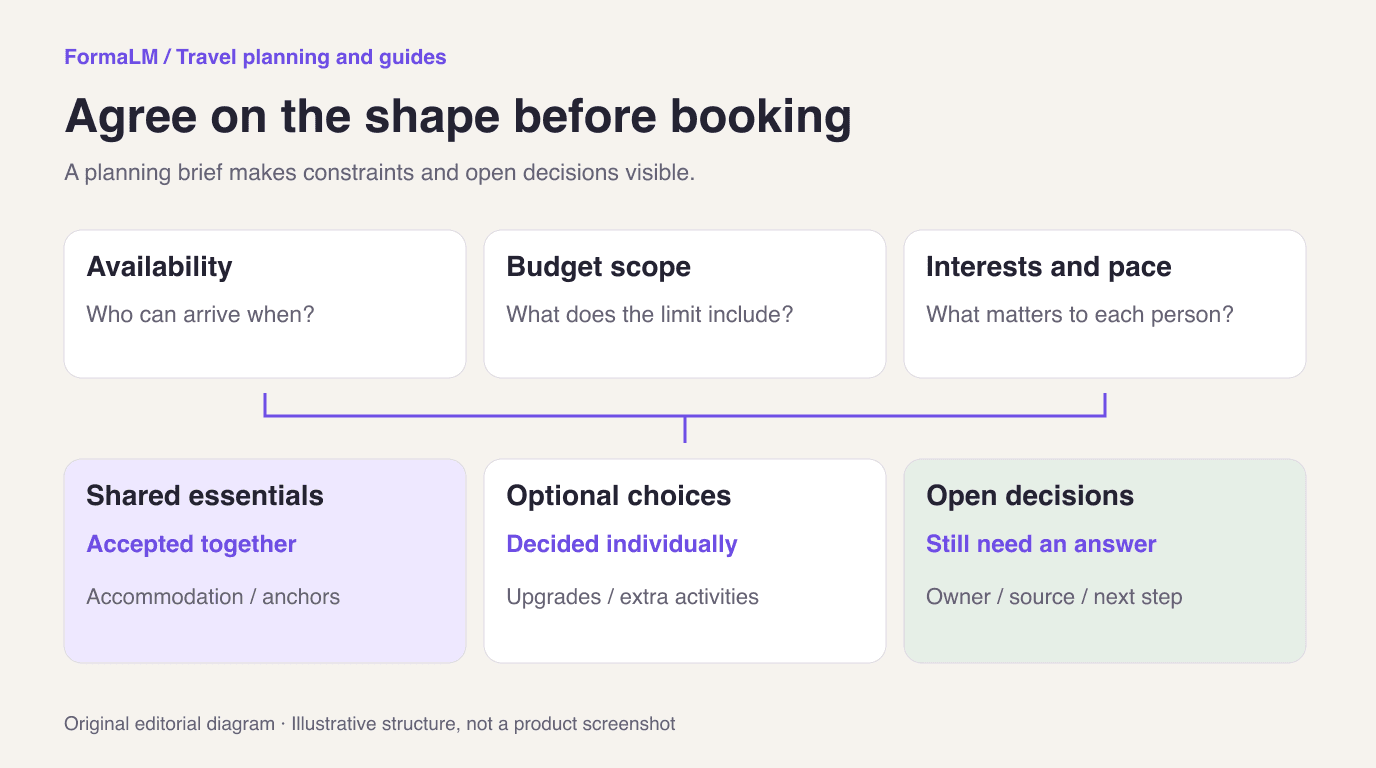
What belongs in a group trip planning brief
Begin with the decision you need from the group. It might be choosing a weekend, agreeing on an accommodation area, or deciding whether a particular activity should be shared. Keep the brief focused on that stage of planning.
| Section | Question it answers | Detail to preserve |
|---|---|---|
| Trip frame | What are we trying to arrange? | Destination or shortlist, purpose, possible dates |
| Individual constraints | What must the plan accommodate? | Availability, spending limits, pace, stated requirements |
| Shared essentials | What are we agreeing to together? | Accommodation, shared transport, agreed group activities |
| Optional choices | What can people decide individually? | Extra activities, upgrades, independent time |
| Open decisions | What is preventing the next step? | Choice, person checking it, source, decision deadline |
Ask people to confirm their own constraints. “Happy with anything” can mean that a person has no destination preference; it does not establish an unlimited budget or agreement to every activity. Give them a way to state what would make the trip difficult.
Collect only the personal detail the planning decision needs. The group may need to know that a pace or accommodation condition matters without needing a person's private explanation.
Collect constraints before comparing destinations
Ask for availability and a comfortable spending boundary before presenting a polished plan. Explain what a quoted limit includes: travel, accommodation, shared activities, personal spending, or only one of those categories. Use one reference currency in the brief and keep estimates distinct from checked prices.
For dates, record the earliest arrival and latest departure each person can manage. For pace, ask about the shape of a day: one main activity with room around it, a fuller schedule, or a mix of group and independent time.
These questions are also part of established group travel planning practice. Princeton's questions for planning group travel cover travel dates, airport choices, accommodation, transport, and meals. Its institutional context differs from a friends' trip, but the questions help identify details that a destination shortlist alone will not settle.
You can collect replies in this small table:
| Traveler | Available window | Comfortable limit and scope | Important preference | Flexibility |
|---|---|---|---|---|
| Name | Earliest arrival / latest departure | Amount, currency, what it includes | One or two priorities | What can move or be skipped |
If you are comparing two destinations, apply the same constraints to both. A lower headline accommodation price can be less useful if it requires a departure one traveler cannot make. Keep the reason for a choice next to the option.
Separate shared commitments from optional plans
The brief should say which decisions involve everyone and which can remain individual. This prevents a preferred activity from becoming a presumed group expense.
For each shared item, record what people are agreeing to and what evidence is available. A proposed accommodation budget is an estimate until the group has checked the actual property and terms. An activity becomes a shared commitment when the relevant people explicitly agree to it.
Keep optional plans in their own section. State who is interested and whether opting out changes any shared cost or timing. Do not hide a disagreement inside a total or describe silence as approval.
Published group itinerary examples from TripSquad also distinguish group activities from open time. A planning brief takes the earlier step: it records the constraints and choices that must be resolved before you can sensibly assign those activities to days.
A filled group planning brief
This is an invented example involving three friends and a fictional weekend destination. The names, amounts, and proposed arrangements are illustrative. They are not a real quote, booking, customer story, or generated product result.
Rin, Sam, and Luis want a two-night visit to Portbridge. They have not booked anything. Their messages produce the following constraint table:
| Traveler | Availability | Example weekend limit | Preference | Open to changing |
|---|---|---|---|---|
| Rin | Friday evening to Sunday afternoon | EUR 240, excluding the journey there | Relaxed mornings | Accommodation style |
| Sam | Friday afternoon to Sunday afternoon | EUR 300, excluding the journey there | One gallery visit | Dining choices |
| Luis | Saturday morning to Sunday evening | EUR 260, excluding the journey there | Time by the harbor | Joining only part of Friday's plan |
The group can now write a short brief:
> Purpose: A relaxed weekend together with one shared cultural activity.
>
> Shared plan to investigate: Two nights near the central station, easy meeting arrangements for Luis on Saturday, and a gallery visit if the date and price suit everyone.
>
> Working boundary: Check whether accommodation and agreed shared activities can fit within EUR 140 per person. This is a planning limit, not a confirmed cost. Leave room within each person's own total for meals and other choices.
>
> Optional: A more expensive dinner and the hill walk. Neither is a group commitment.
This draft exposes two issues before booking: Luis will miss Friday, and the shared-cost proposal needs actual prices. It also preserves Rin's preference for a slower pace rather than filling every morning.
Make the next decisions explicit
| Decision | Evidence needed | Person checking | Next step |
|---|---|---|---|
| Accommodation for two nights | Current price, room arrangement, cancellation terms | Rin | Present options within the shared limit |
| Saturday meeting point | Arrival details and a location the group can find | Luis | Confirm before finalizing Saturday |
| Gallery as a shared activity | Current ticket information and everyone's agreement | Sam | Keep optional until confirmed |
A decision deadline should be chosen by the group. Write down the decision when it is made, including anyone who will participate differently. The brief can then become the input for a day-by-day travel itinerary.
Turn group messages into a draft in FormaLM
The Group trip template asks for Destination and Group preferences. Add the travelers' availability, budget scope, interests, constraints, and choices still open. Say which details are confirmed and which are suggestions.
For the fictional example, a useful instruction would be:
> Draft a discussion plan for three friends visiting fictional Portbridge. Preserve the different arrival windows and budgets below. Keep the gallery and expensive dinner optional until agreed. List unresolved choices with the information needed to decide them. Do not invent current prices or imply anyone has approved a booking.
FormaLM supports a web page or carousel for this template. Review the draft with the people involved before using it as a shared reference. The template creates planning content; this guide does not establish a live voting system, booking service, payment ledger, or automatic fairness optimizer.
Know when the brief is ready to become an itinerary
The brief is ready for scheduling when the group can identify the dates, the constraints that must be respected, the commitments everyone has actually accepted, and the choices that remain optional.
If a major choice is still open, keep it visible. You can share the brief for discussion without presenting it as a settled trip. Once the anchors are agreed, build the itinerary around them and retain the brief as the record of why those choices were made.
After the trip, a travel guide made from your notes can share the places and observations worth passing on. Leave individual budgets and private group discussions out of that public-facing version.