
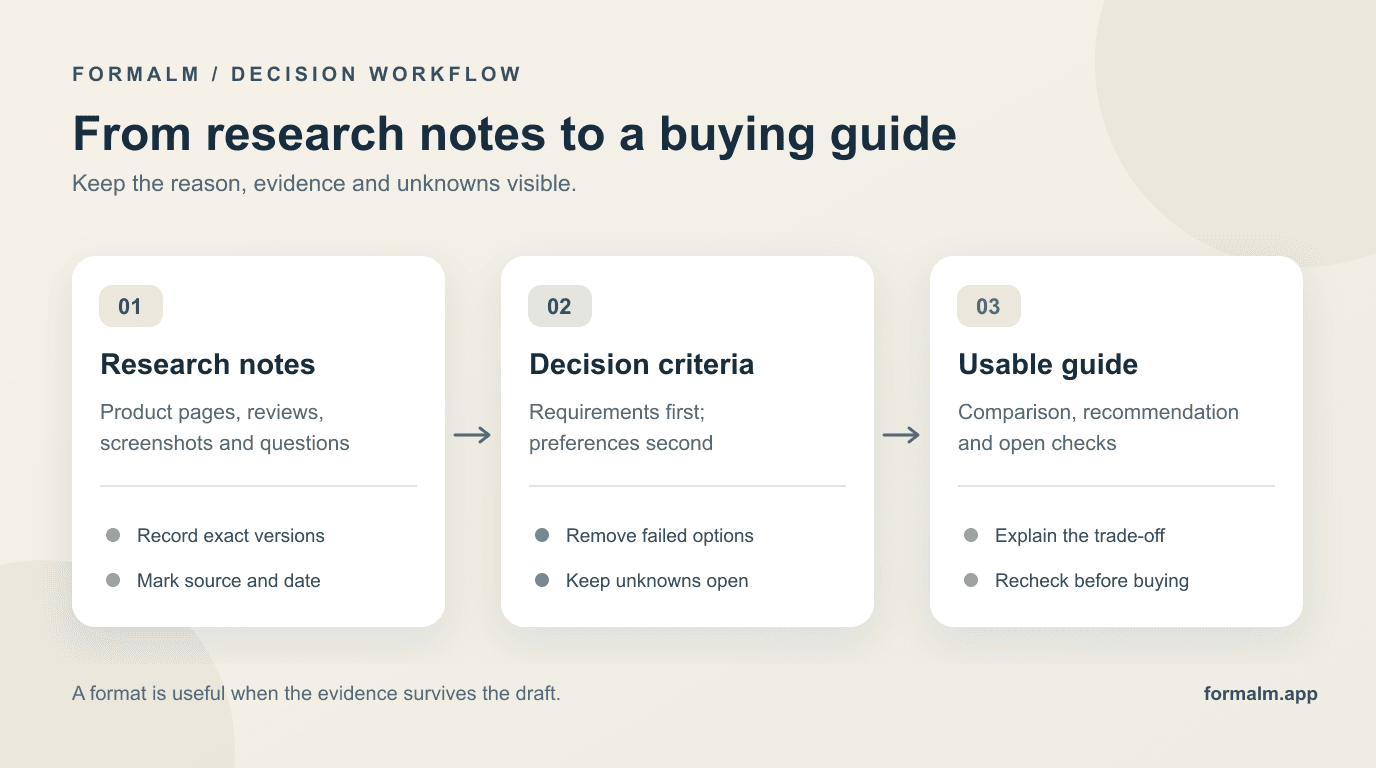
What a buying guide from research notes needs to answer
A guide should make five things easy to find: who the purchase is for, what would make an option unsuitable, which candidates remain, why one fits best, and what still needs checking. That is different from a comparison infographic, which can show a few differences quickly but rarely has room for source quality, exceptions, and unresolved questions.
Start with this compact structure:
| Section | Question for the reader | Material to bring in |
|---|---|---|
| Decision | What are we buying, for whom, and for what use? | One-sentence need and budget boundary |
| Requirements | What must an option do? | Deal breakers and measurable constraints |
| Shortlist | Which options are being compared? | Exact model or version, not a brand alone |
| Evidence | What supports each important difference? | Product pages, specifications, independent reviews, dates |
| Recommendation | Which option fits the stated use, and why? | Trade-offs and who might choose differently |
| Open checks | What could change the decision? | Unverified price, compatibility, returns, availability |
Many public buyer-guide examples are written for stores and end at a product link. Shopify's guide to creating buyers guides describes the common reader questions and comparison elements. If your purpose is a private decision or a useful recommendation to someone else, the final section may instead be a short list of checks before any purchase.
Start with the use, budget, and deal breakers
Write the use in a sentence specific enough to exclude irrelevant features. “A desk lamp” is a category. “A lamp for reading at a narrow desk, with a light that can be directed away from the screen” is a decision. Record the total spending boundary and whether it includes accessories, delivery, or replacement parts.
Separate must-haves from preferences. A product that fails a real must-have should leave the shortlist; it should not win back its place by collecting points for minor extras. Preferences help choose among the options that remain. This is the same distinction a focused product comparison method makes, but here the distinction becomes the spine of a shareable guide.
For each criterion, ask how you would verify it. “Easy to use” is an impression. “The control can be reached without moving the lamp” can be checked through dimensions, a manual, a demonstration, or actual use. If no reliable check is available, say so. A neat score cannot repair missing evidence.
Sort notes by claim and source
Do not paste every saved note into the final guide. Extract only claims that could change the choice. Give each one a label:
- Checked specification: an exact measurement or supported feature from a current manufacturer document for the exact version.
- Observed experience: what someone actually tested, with the conditions and limits of that observation.
- Reported pattern: a concern or benefit seen across reviews, with enough context to assess whether it applies.
- Unverified claim: a listing, screenshot, or AI summary that still needs confirmation.
The labels prevent a polished sentence from quietly upgrading a sales claim into an independent test. The FTC's advice on evaluating online reviews recommends checking the source, recency, and variety of reviews; it also cautions that appearance alone cannot reliably identify a fake review. A buying guide should preserve those limits when a review influences the recommendation.
Make a simple evidence ledger while researching. It can stay in your notes rather than appear in full in the final page:
| Claim | Source and date checked | Status | Decision effect |
|---|---|---|---|
| Candidate fits the available space | Current dimensions for the exact model | Checked specification | Required |
| It remains comfortable after long use | One reviewer describes a trial | Limited observation | Preference; seek more evidence |
| Returns are possible after opening | Store policy not yet checked | Open | Could change the choice |
Prices, stock, and return terms can change. Keep the source link and the date of your check near any claim whose freshness matters. If you plan to publish a guide with affiliate links or another material relationship, disclose that relationship clearly near the recommendation. Do not present commissioned recommendations as independent testing.
Compare only options that pass the hard requirements
Limit the shortlist to a few comparable options. Compare the same version and purchase condition across rows: a base model and a premium bundle are different offers. Use the same criteria for each candidate, including any unknowns. Do not give one product a detailed weakness section while describing another only through marketing highlights.
Avoid a single total score when one failure would outweigh every minor advantage. A short judgment for each option is often clearer: fits the use, fits with a compromise, cannot yet recommend, or fails a requirement. Add the reason next to the judgment.
When two choices serve different people, say who each is for. A buying guide does not need a universal winner. It may conclude that more information is needed or that the reader should keep what they already own.
A worked buying guide with invented options
The following is an invented example about a reading lamp. “Lamp A” and “Lamp B,” their properties, and the person below are fictional. This is a demonstration of the guide's structure, not product testing, a current price check, or a real recommendation.
Decision: Mira needs a lamp for evening reading at a small desk. She wants the light pointed at the book rather than the screen and does not want a fixture that needs permanent installation. Her spending limit covers the lamp and delivery.
| Criterion | Lamp A | Lamp B | How to treat it |
|---|---|---|---|
| Fits the desk footprint | Appears to fit from the fictional dimensions | Appears to fit from the fictional dimensions | Verify the actual base dimensions before buying |
| Directs light away from screen | Has an adjustable arm in the fictional description | Direction is unclear | Treat B as unresolved, not as a failure or a pass |
| No permanent installation | Freestanding in the fictional description | Freestanding in the fictional description | Both pass the stated requirement |
| Return terms | Unknown | Unknown | Check the current seller terms for either option |
Working recommendation: Lamp A is the more promising candidate because its described adjustment addresses Mira's specific use. It is not purchase-ready. The desk measurement and current return terms still need checking. Lamp B remains an alternative if its light direction can be confirmed. This answer is more useful than awarding A a made-up score of 87 and hiding the open questions.
For a real decision, replace each fictional cell with a link to the exact product version and a date checked. If a claim came from someone's experience, name the conditions or quote only what you are permitted to use. If you have not handled the product, say that the guide is based on research rather than testing.
Turn the decision into a page someone can use
Once the evidence is organized, draft in this order: the decision, the requirements, the shortlist, the comparison, the provisional recommendation, then open checks. Put the reason for the recommendation before long background. Link source details where they support a claim rather than collecting a pile of links at the bottom.
FormaLM's Buying guide template asks for what you need and your needs and budget. It accepts reference links, documents, and images, and supports a web page or infographic. For a guide with source notes and unresolved checks, a web page usually gives those qualifications more room. An infographic can work when the criteria and trade-offs are already stable and brief. Bring in the evidence ledger, specify which details are unverified, and review the generated draft against the original sources before sharing it.
This template shapes a guide; it does not independently test products, check live prices, confirm stock, or make the purchase. The buying-guide template page is the creation entry point. This article supplies the research and judgment method before that step.
If your material is primarily screenshots of a product you already know, see how to make a product guide from screenshots. If the answer must fit in a visual comparison rather than a detailed page, use the comparison infographic method.
Check the guide before acting on it
Read the finished guide as the person making the purchase. Can they identify the exact version being compared? Can they tell what was checked, what was reported, and what remains unknown? Would a changed price, return policy, or compatibility detail alter the recommendation? Can someone who prefers a different trade-off see a reasonable path through the same evidence?
If the answer to a decisive question is missing, leave the guide marked as provisional. A finished buying guide does not have to force a purchase. It has to make the next decision, or the next check, clear.