
Introduction
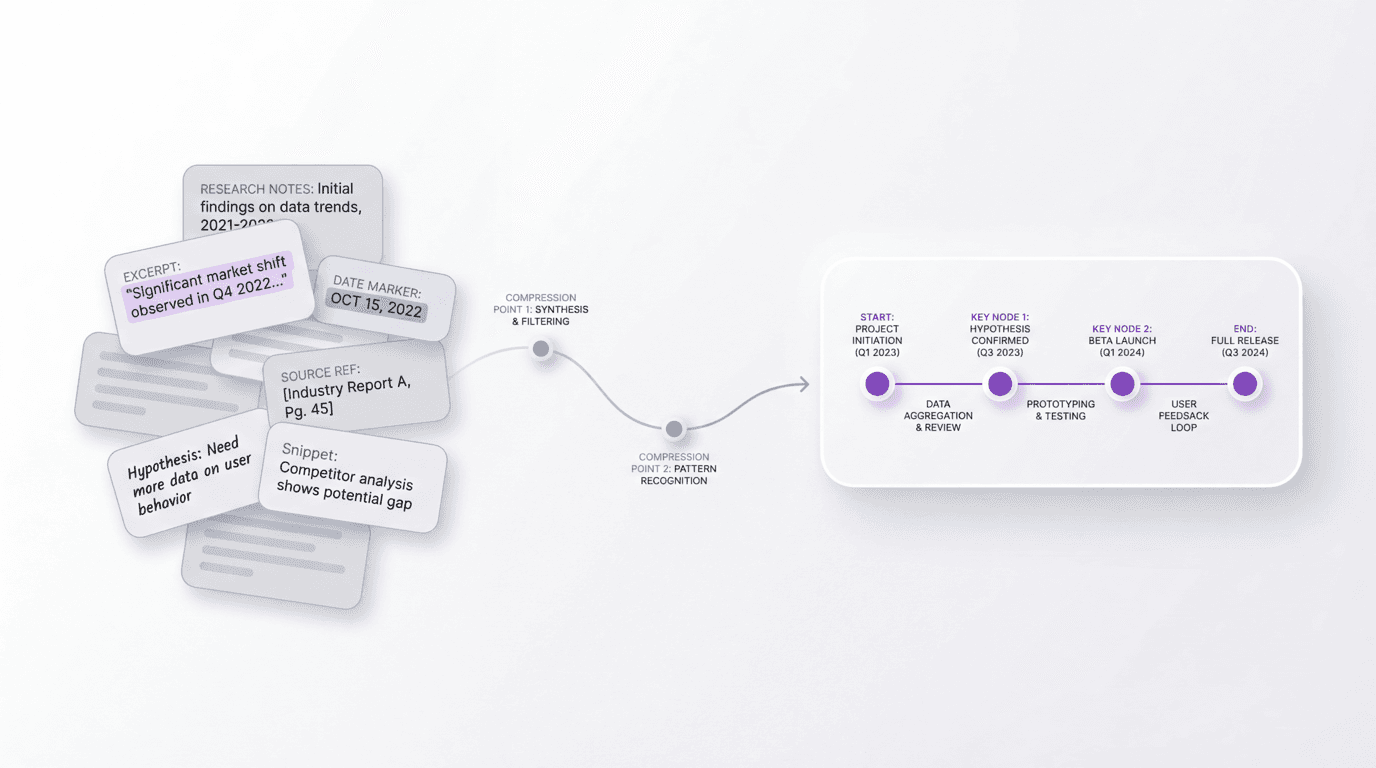
The format asks an immediate set of questions: what came first, what changed next, which moments matter, and what can be left out. Once that boundary is visible, the work moves toward a finished result instead of expanding into more research reading.
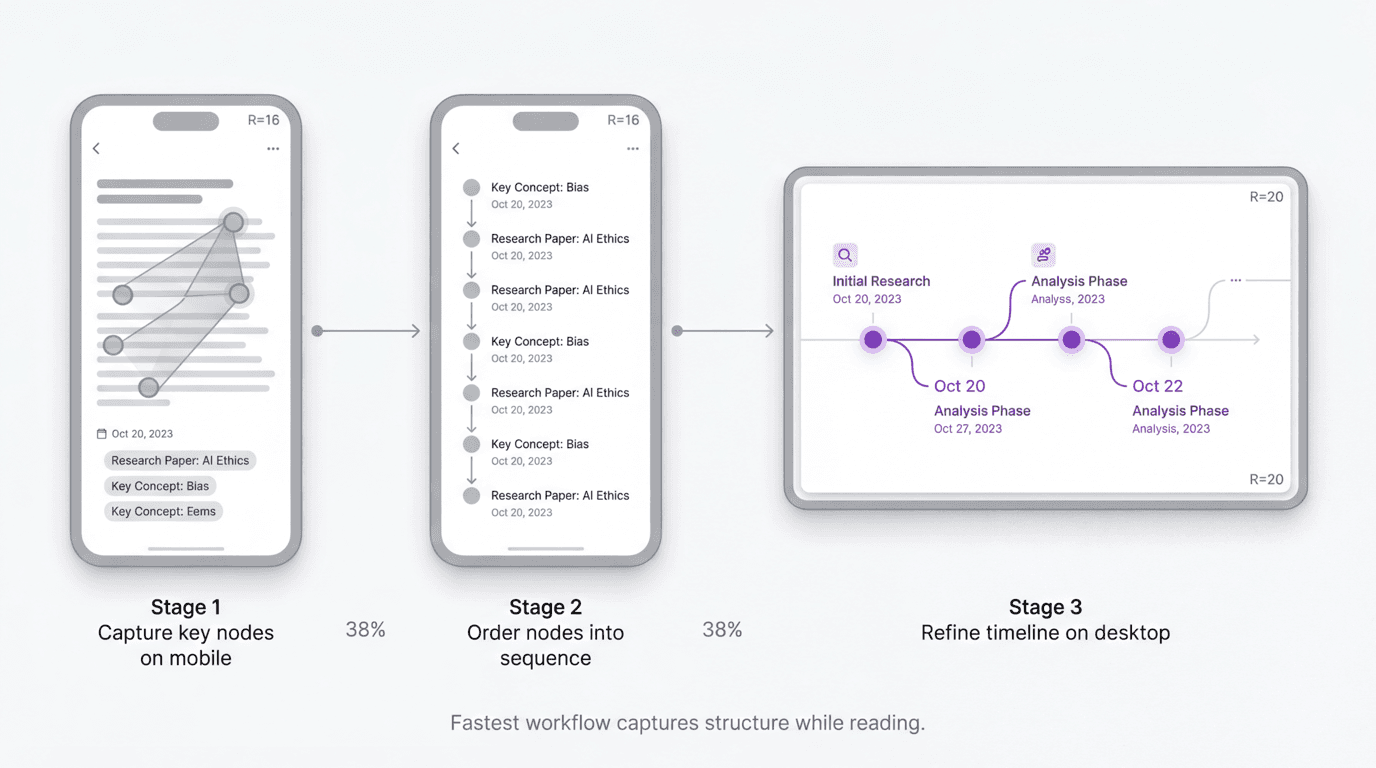
The useful move is to catch the key nodes as they appear, then answer focused questions to confirm dates, explain transitions, fill gaps, and tighten the finished sequence. That capture can happen while reading on any device; the method matters more than where it starts.
FormaLM uses that clear boundary to move the research from open-ended synthesis toward a concrete job: identify the key nodes, order them, and shape them into a usable timeline.
A timeline gives research a stronger frame than a summary does
A summary is useful when the main job is compression.
A timeline is useful when the main job is understanding change over time.
That distinction matters because many research sets contain too much movement to stay legible inside a normal summary. The material may include events, decisions, releases, turning points, responses, revisions, or external shifts that only really make sense once their order becomes visible.
The timeline is useful because it makes that sequence visible.
It forces the research into a smaller number of moments that can be sequenced, compared, and read as progression rather than accumulation.
That does not mean every research project wants to become a timeline. But when the central question is how something unfolded, when a shift happened, or how one development led to another, the timeline often gives the clearest frame available.
When research should become a timeline
Not all research material benefits from timeline treatment.
The format works best when the order and timing of events matter.
That often includes:
- product or company history
- policy or regulatory change
- market evolution
- incident or event analysis
- project or launch reconstruction
- research on how an idea developed over time
In these cases, a timeline is useful because it does more than store facts. It creates an interpretive boundary. It tells you which moments deserve to survive and asks you to place them in relation to each other.
A timeline can also help finish the research. Once you choose the format, you stop trying to preserve every note and start building a coherent sequence.
Start by catching the key nodes, not the whole chronology
Many people make the job harder by trying to include every date and detail.
They assume turning research into a timeline means reconstructing every date and detail from the beginning.
Usually it does not.
The better first move is to catch the key nodes while you are still reading. Look for the moments that feel structurally important:
- first launch or release
- major shift in strategy
- key decision or turning point
- event that changed what came after
- milestone that clarifies the rest of the sequence
These are often easier to identify than the full timeline itself.
The useful insight often appears mid-read, when you notice that a particular date or event is probably one of the anchors. If you save those nodes early, you reduce the amount of reconstruction work later. Focused questions can then expand from those anchors instead of asking you to rebuild from the full source material every time.
FormaLM fits this especially well because it helps preserve the format choice early. Once the reading suggests a timeline, the work no longer has to stay open-ended. You can start collecting the future structure while the research is still unfolding.
A simple workflow for turning research into a timeline
If the material clearly wants to become a timeline, the workflow is usually straightforward:
- capture the key nodes while reading
- sort those nodes into tentative order
- add only the context needed to explain transitions
- remove details that do not change the sequence
- refine the timeline into a finished version for the actual audience
That middle step matters more than it first appears.
A timeline gives meaning to a list of dates. The reader should see what happened and how one moment changed the next. Short transitions or milestone labels can explain that movement better than raw chronology alone.
The stronger the sequence becomes, the less explanation the reader needs elsewhere.
A practical example: turning product research into a timeline
Imagine you are researching how a product category evolved over three years.
Your source material includes launch notes, press coverage, internal observations, screenshots, and a few industry reports. At first it feels too broad. There is too much material, and most of it is not equally important.
A timeline creates the first strong filter.
Instead of keeping everything, you start pulling out:
- the initial category launch moment
- the first major shift in positioning
- the point where the product moved upmarket
- the release that changed user adoption
- the later consolidation or backlash moment
Now the research has a sequence instead of remaining a pile of evidence.
From there, you can add brief explanation to each node, clarify the transitions, and decide whether the final output should stay as a plain reference timeline or become a more visual narrative asset.
A timeline gives research a clear, achievable result.
What to leave out when building the timeline
One reason research timelines become bloated is that the writer tries to preserve too much source detail.
That usually weakens the timeline.
The job is not to prove that you read widely. The job is to make the sequence understandable.
That means leaving out:
- background detail that does not change the sequence
- duplicate evidence supporting the same node
- dates that are precise but not important
- side facts that interrupt the main line of change
The format is most useful when it forces those choices.
A timeline forces exclusion. It makes you decide whether a detail genuinely deserves a place in the progression or whether it belongs in notes, not in the final output.
That boundary is valuable. It is one of the main reasons timeline work feels more finishable than a loose research summary.
Refine the timeline once the structure is visible
The first useful pass often happens during reading.
The cleaner finishing pass usually happens later.
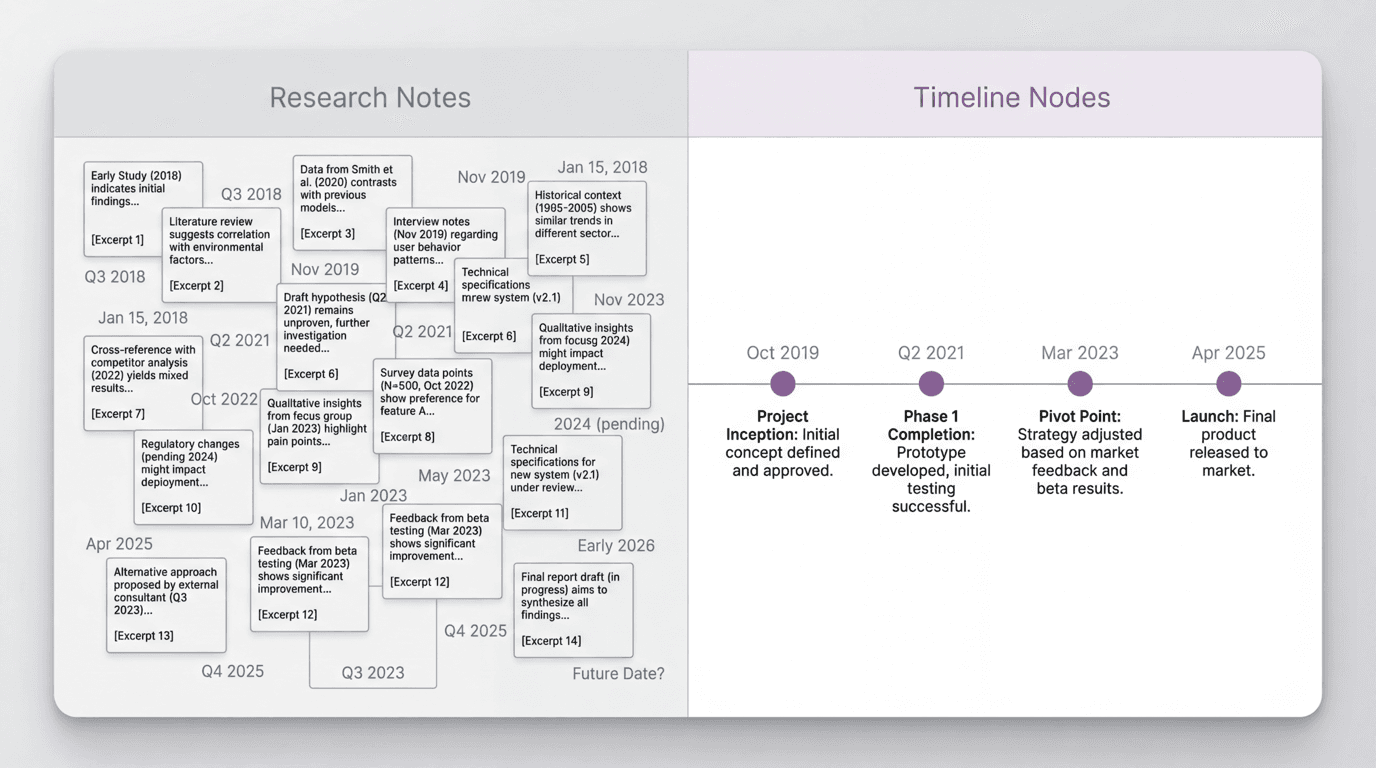
This division keeps capture simple. Save the dates and moments that probably belong, then use focused questions to check gaps, refine labels, tighten descriptions, and make the sequence easy to read.
Before refining a date, check its source and mark what remains uncertain. Recap's source-grounded document checklist provides a field-level review method for that step.
This matters because many timeline tasks stall when people wait too long for the perfect build session. By the time they return, the logic that felt obvious during reading has become diffuse again.
The better workflow is lighter. Catch the nodes while the structure is visible. Then answer only what is needed for refinement, not rediscovery.
FormaLM is especially strong in this middle stage. It helps the timeline move from rough capture to finished result once the format is fixed, which is usually the point where momentum is easiest to lose.
When to keep the timeline simple, and when to make it visual
A plain timeline is often enough.
If the main job is analysis, internal alignment, or reference, a simple ordered structure with dates, node labels, and short context is usually the strongest format.
A more visual timeline becomes useful when the final output needs to be explained to others quickly, such as in a presentation, article, internal brief, or category narrative.
The important thing is not to force the visual layer too early.
The right order is usually:
- stabilize the sequence
- decide what each node needs to say
- decide whether a visual form would help the audience
That keeps the timeline from turning into a design project before the research logic is clear.
A timeline makes the next decisions clear
A timeline makes it easier to see which events belong, what details are still missing, and what can be left out.
FormaLM helps move the source material through those decisions and into a usable sequence faster.