
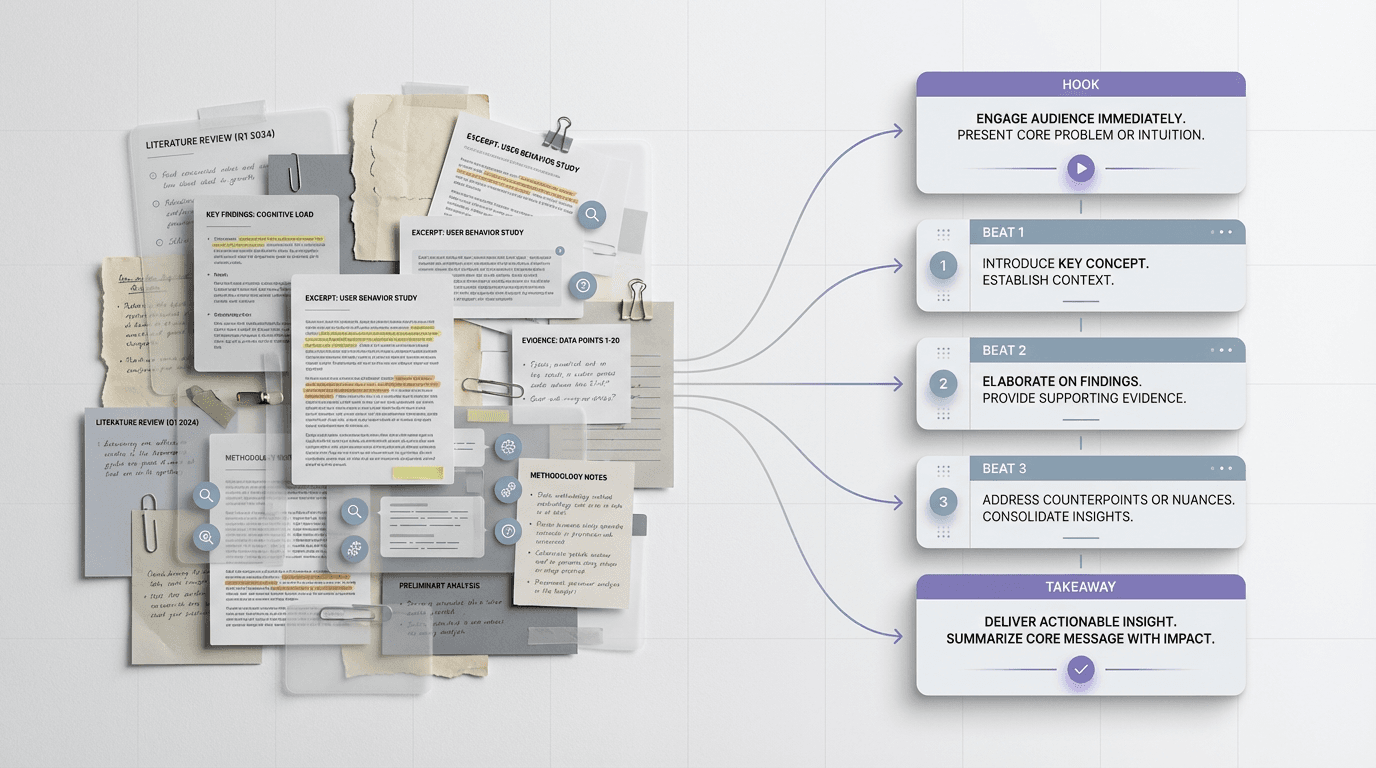
A short video is not a compressed research archive
Research is allowed to be broad, evidence-heavy, and layered. A short video cannot be.
A short video has much tighter constraints. It has less time, less room for qualification, and far less tolerance for detours. The viewer is not sitting down to inspect the whole argument. They are deciding, moment by moment, whether the sequence is clear enough to keep watching.
Decide which part of the research deserves to survive the format change. Start with what the video needs to say, then select the notes that support it.
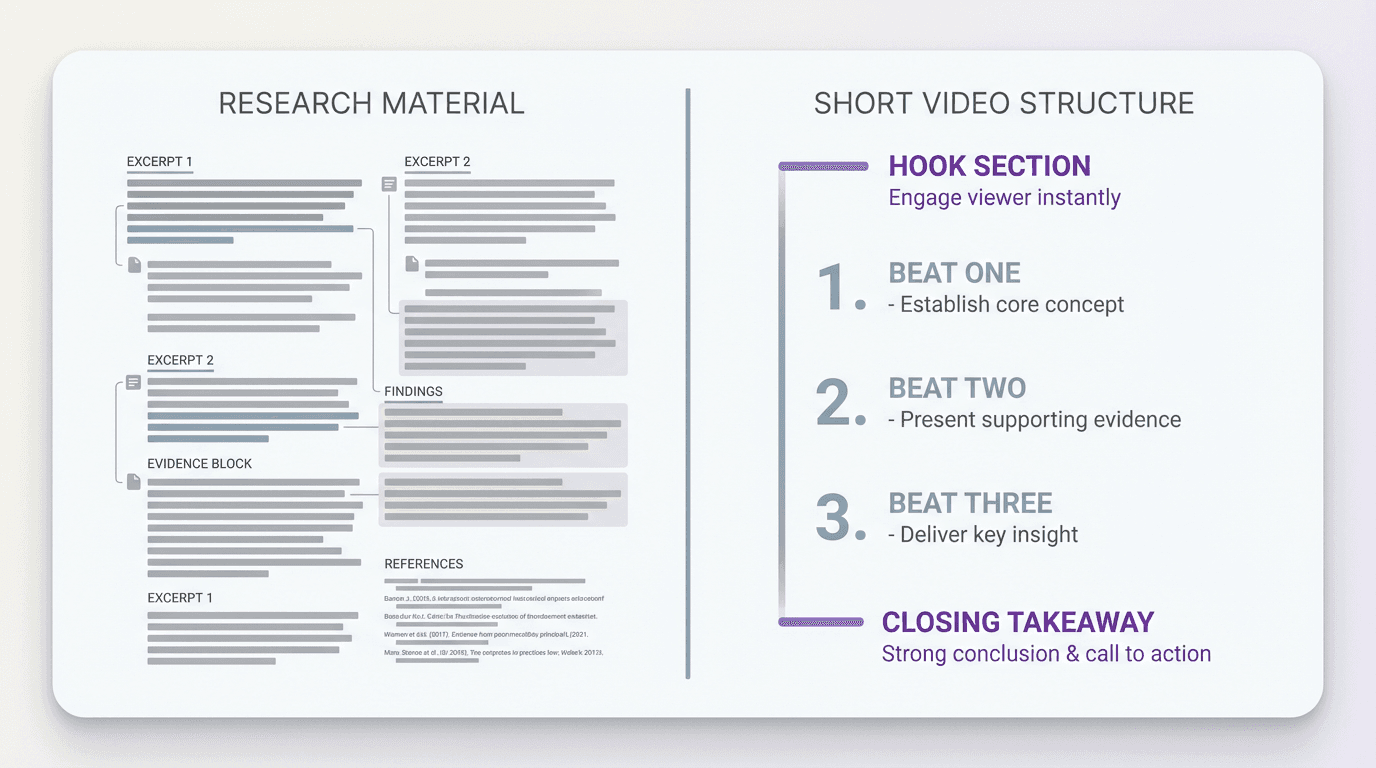
Start with the one takeaway the video should leave behind
Most weak research-to-video attempts preserve too much.
The author has several useful findings, a lot of nuance, and multiple interesting supporting details. Instead of choosing one central point, they try to fit all of it into the video. The result often feels crowded before scripting has even properly started.
The better move is to choose one takeaway.
That takeaway becomes the spine of the short video. It tells you which findings belong, which examples support the story, and which interesting details should stay in the source layer instead of entering the script.
For example, if the research is about changing buyer behavior, the takeaway might be:
"People are not ignoring the product. They are deferring the decision because the risk feels unclear."
If the research is about internal workflow issues, the takeaway might be:
"The bottleneck is not missing information. It is that the current handoff structure hides what matters."
With the takeaway set, you can turn one supported idea into a sequence the viewer can follow.
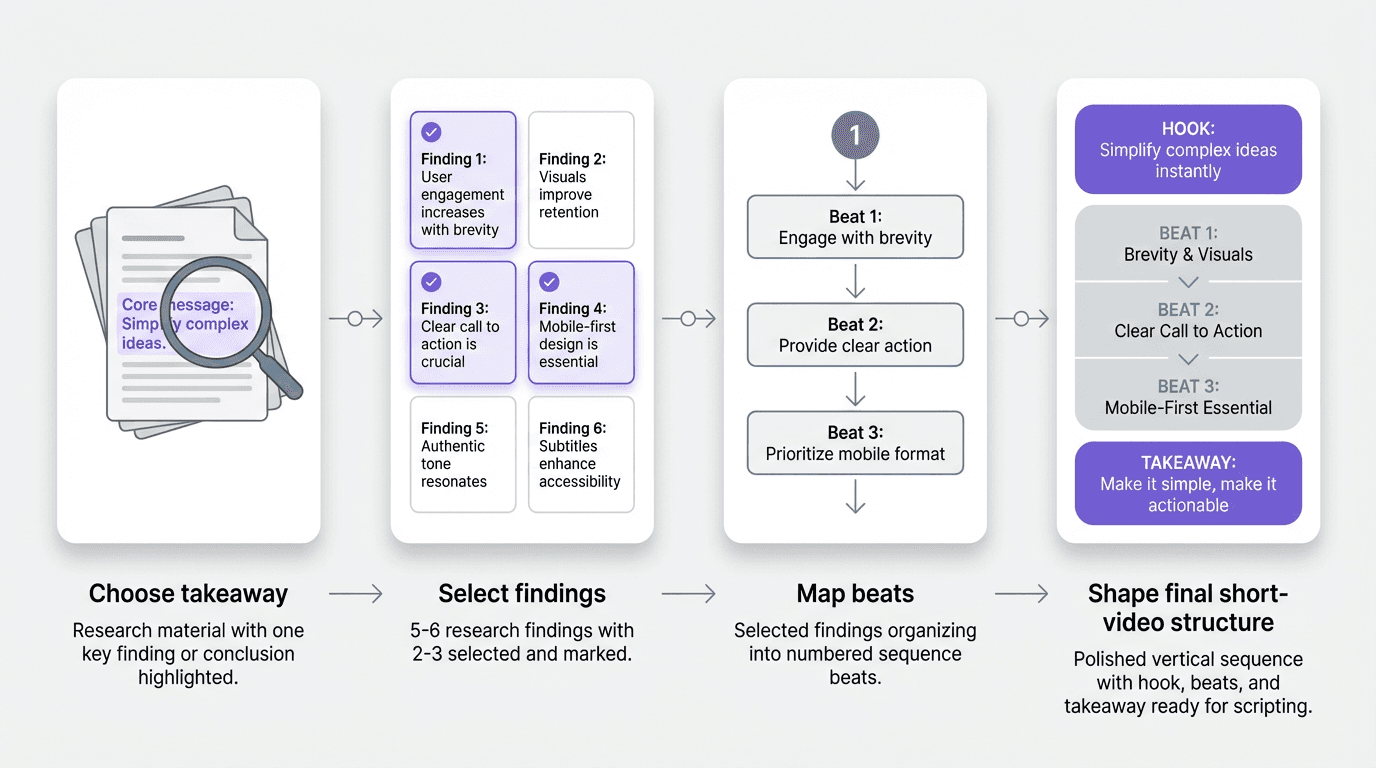
Choose the few findings that can survive video speed
Not every good research point belongs in a short video.
A short video usually has room for:
- one hook
- one central claim
- two or three supporting beats
- one ending or implication
So the findings you keep should do real work. They should either sharpen the core claim, create a meaningful turn in the sequence, or make the takeaway easier to believe. If a finding is interesting but does not move the structure forward, it may belong in the caption, comments, follow-up content, or source document instead.
Research-to-video work therefore involves choosing for movement as well as reducing length.
Turn the research into beats before you turn it into script
Before writing full lines, define the beats.
A beat is not a full sentence. It is the job of a moment in the video.
A useful beat structure often looks like this:
- opening tension or surprising fact
- reframe of what is really happening
- evidence beat
- implication or example
- closing takeaway
Not every video needs exactly five beats, but most good short videos use a similar progression. Choosing the beats first keeps the script focused before the wording gets too detailed.
If you skip this step, the script often becomes an awkward mix of research notes, half-written narration, and ideas that are still out of order. The work then feels much larger than the short video it should produce.
Write for spoken clarity, not research precision
Once the beats are visible, write for spoken delivery.
Research language is built for accuracy, qualification, and evidence. Short-video language is built for comprehension under speed.
That does not mean the video should become careless. It means the wording has to carry the idea faster.
In practice, that usually means:
- shorter sentences
- fewer subordinate clauses
- less setup before the point
- stronger verbal contrast
- one idea per line or moment
A research sentence might say:
"Interview data suggests that users delayed implementation because the onboarding flow created uncertainty about the amount of work required before value would become visible."
A short-video version might become:
- People were not rejecting the product
- They were delaying the setup
- The value felt too far away
The meaning survives, and the line becomes speakable.
Keep the strongest proof in the middle of the sequence
One common mistake is trying to explain everything too early.
The opening does not need the full argument. It needs enough tension or curiosity to make the next few seconds worth watching.
The middle is where the proof should do its work.
That may be:
- the strongest finding
- the clearest contrast
- the one example that makes the insight obvious
- the pattern that changes how the viewer interprets the problem
If you spend your best material too early, the rest of the video often flattens out. If you delay all the proof too long, the video can feel vague. The right balance is usually simple: hook first, clarification second, strongest proof in the middle, then the takeaway.
Decide what stays in the video and what stays outside it
This boundary matters more than most people expect.
Not every supporting point needs to be spoken inside the video itself. Some material is better kept nearby rather than inside the core sequence.
Good candidates for the video:
- the main claim
- the few findings that support it
- the key example or contrast
- the takeaway that finishes the idea
Good candidates for outside the video:
- methodological detail
- extra examples
- caveats
- secondary findings
- links to fuller explanation
That separation protects the video from becoming overloaded while still letting the research stay intact.
Turn the selected research into a video draft
The video needs a clear hook, ordered beats, selected findings, and language that works when spoken.
Research tools often stop at organized material, while video tools expect a script or plan. FormaLM turns the source into a draft that is ready for scripting and production.