
Introduction
A reusable research summary template gives the summary a job. It helps decide what belongs in the document, what should stay in the appendix, and what the reader needs in order to act.
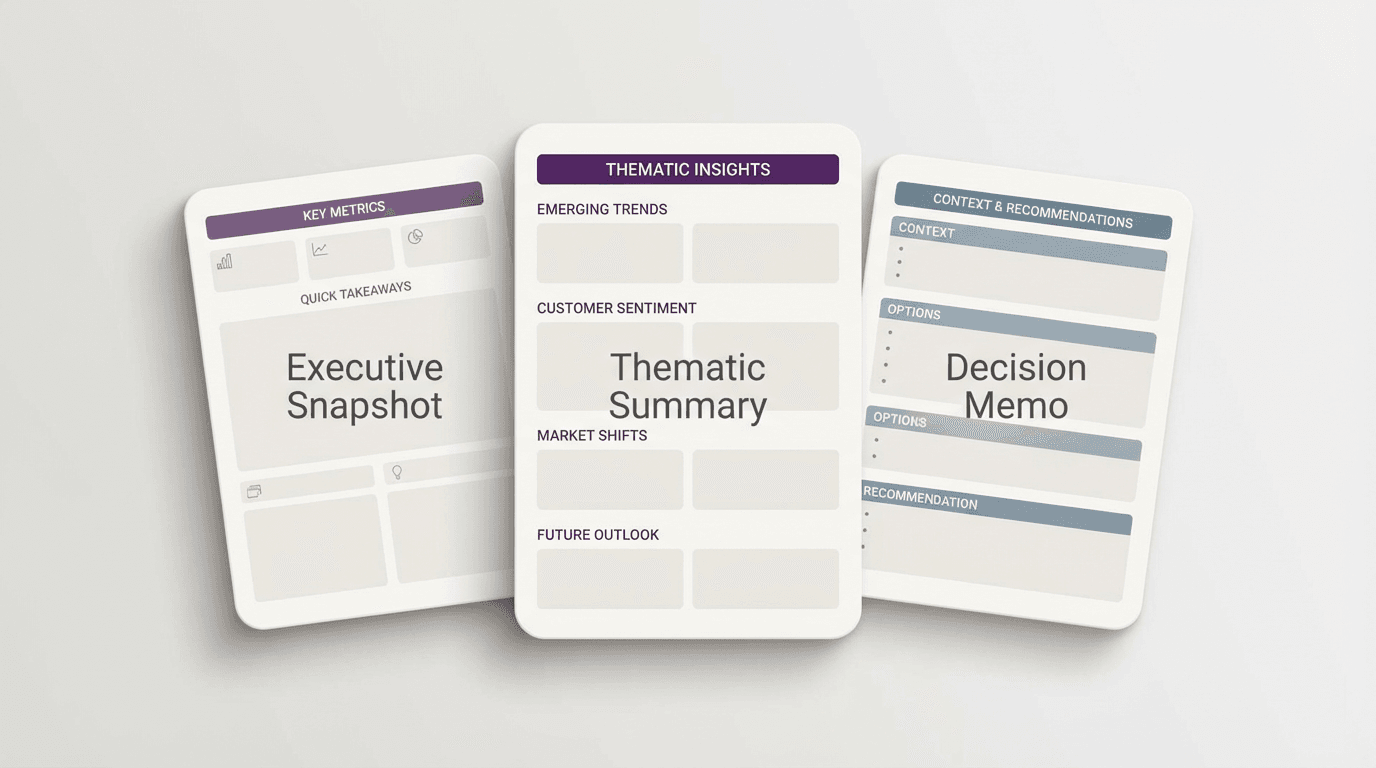
This article walks through three research summary template formats you can reuse, depending on the kind of handoff you need to make. Each one includes a filled example so the target shape is visible, not abstract.
A research summary template is a handoff format
Most teams treat a research summary as a recap. That framing is too weak.
A summary is a handoff document, not a shorter copy of the raw work. Its reader, decision context, and required level of clarity determine what belongs. An executive needs a different summary from a designer preparing a flow revision. A content team may need patterns and evidence more than recommendations.
No single research summary template suits every case. Start with what the next person needs from the summary.
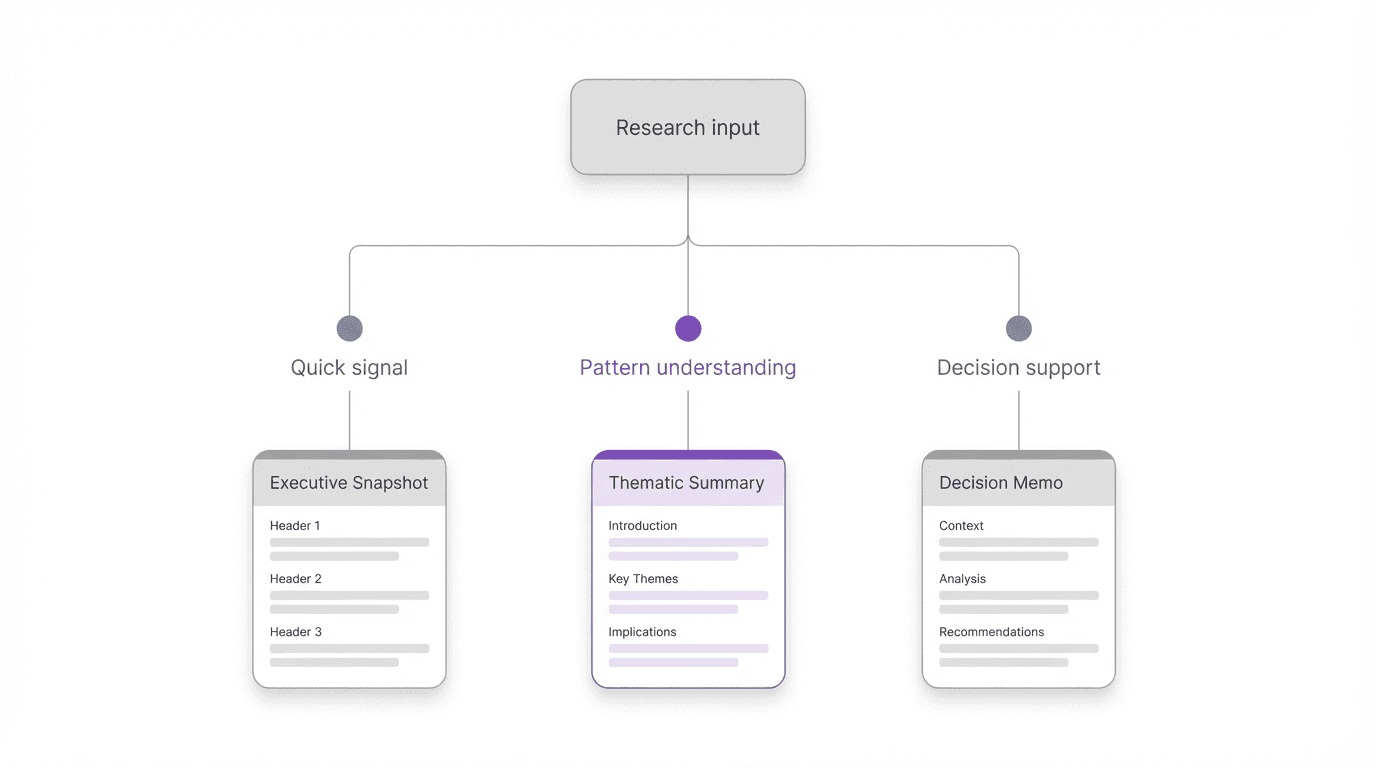
Usually, the answer falls into one of three jobs:
- understand the headline quickly
- understand the patterns across the research
- understand what decision the findings support
Those jobs map cleanly to three reusable formats.
Format 1: Executive snapshot research summary template
Use this format when the reader needs the answer fast.
Use this research summary template for leadership reviews, weekly updates, stakeholder recaps, and any situation where the summary must travel across teams without much explanation. Keep it short, selective, and easy to scan.
Recommended structure
- Research objective
- What was studied
- Top three findings
- Why the findings matter
- Recommended next move
Hypothetical example
Scenario: a product team ran eight onboarding interviews for a new analytics feature aimed at operations leads.
Research objective
Understand why trial users stop during setup before connecting their first data source.
What was studied
Eight remote interviews with trial users from teams between 20 and 150 employees. Sessions focused on setup expectations, technical confidence, and first-session friction.
- Interviewees in this hypothetical scenario expected a guided setup path, but the product looked self-serve and open-ended.
- The phrase "workspace source mapping" caused hesitation because it sounded technical before value was clear.
- Users wanted to know what the finished state would look like before starting configuration.
Why the findings matter
The onboarding drop-off comes from both the setup and the way the outcome is presented. The flow asks users to configure too much before they understand what they will get.
Recommended next move
Test a first-run setup sequence with a clearer destination preview, simpler step labels, and one default mapping path.
This template works for busy readers because it leaves out the research process and shows the finding, why it matters, and what should happen next.
Format 2: Thematic research summary template
Use this format when the reader needs to understand the patterns behind the headlines.
This longer research summary template suits design teams, content teams, researchers, and cross-functional collaborators who need more depth than an executive recap without receiving a raw transcript dump.
Recommended structure
- Research goal and scope
- Method and sample
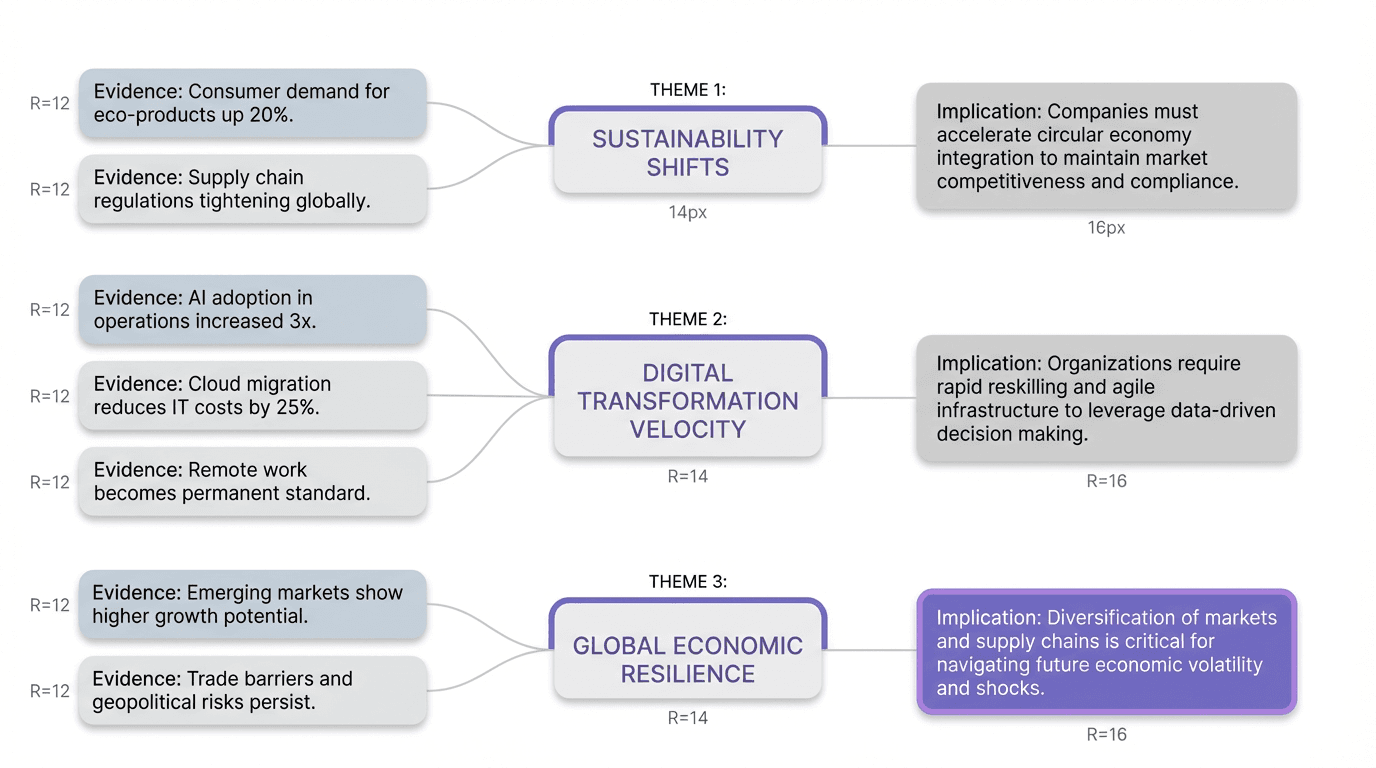
- Theme 1
- Theme 2
- Theme 3
- Implications for the work
- Open questions
Hypothetical example
Scenario: a content team reviewed twelve customer interviews and support transcripts to understand why users struggled to create internal process docs.
Research goal and scope
Identify recurring friction in how teams turn rough operational knowledge into shareable documentation.
Method and sample
Twelve interviews with operations managers and team leads, plus a review of recent support conversations related to drafting and template use.
Theme 1: People start with raw material, not with document structure
Most participants already had notes, checklists, or message threads. The friction appeared when they had to shape those fragments into something another person could follow.
Theme 2: Blank-page drafting created unnecessary rewrite work
Teams often rewrote from scratch instead of promoting stable pieces such as objective, process steps, owners, and exceptions into a known format.
Theme 3: Completion was blocked by uncertainty about what "done" looked like
Participants were unsure whether a draft was complete enough to share. The absence of a visible document shape made finishing harder.
- Product messaging should emphasize moving from rough material to a finished format.
- Templates should expose structural slots early, not after the user has already drafted.
- Examples should show how to begin and what a usable finished document looks like.
- Do teams need different templates for SOPs, briefs, and summaries, or can one base structure cover multiple jobs?
- Which format cues make users feel a draft is ready to share?
This format is stronger when the findings are cumulative. It gives the reader enough evidence structure to trust the summary without turning the document into a full report.
Format 3: Decision memo research summary template
Use this format when research needs to support a specific product, content, or workflow decision.
This version is useful when the summary will be read inside planning, prioritization, or review. It is more directional than the first two formats because it connects findings to a decision frame.
Recommended structure
- Decision to be made
- Relevant research inputs
- What the evidence says
- Risks or constraints
- Recommendation
- What to test next
Hypothetical example
Scenario: a team needs to decide whether to launch a flexible blank editor first or lead with structured starting formats.
Decision to be made
Should the first-run experience start with a blank editor or a set of content templates?
Relevant research inputs
For this hypothetical decision memo: onboarding interviews, trial-session recordings, and support logs from people who started drafts but did not finish them.
- In this scenario, people with rough intent moved faster when the product suggested a document shape early.
- Open drafting helped experienced users, while newer users treated it as extra composition work.
- Examples and fixed sections helped people understand what the result should include.
- Over-structuring could make advanced users feel boxed in.
- Template naming must stay concrete or users will not know which option to choose.
Recommendation
Lead with structured starting formats in the first-run flow, while preserving a visible path to open drafting for experienced users.
What to test next
Compare completion rates and draft quality between a format-first first-run flow and a blank-editor first-run flow.
This research summary template is especially useful when the audience is debating direction. It prevents the summary from stopping at "here are the findings" and instead helps the team move toward a decision with evidence in view.
How to choose the right research summary template
The easiest mistake is choosing the longest format by default.
That usually happens because the author wants to preserve nuance. But nuance is not the same thing as usefulness. A strong research summary template is the one that matches the reading context.
Use the executive snapshot when:
- the reader needs the main signal quickly
- the summary will be forwarded widely
- the next step matters more than methodological detail
Use the thematic summary when:
- the reader needs to see repeated patterns
- the work will inform design, content, or workflow changes
- multiple insights need to be held together without becoming a full report
Use the decision memo when:
- the team is choosing between directions
- evidence needs to be tied to a recommendation
- tradeoffs need to stay visible in the summary itself
One practical rule helps: if the reader finishes the document and still does not know what to do with the findings, the format is wrong.
A simple research summary template checklist
Before you share the document, check whether the summary includes:
- a clear objective or decision context
- enough method detail to establish trust
- findings shaped for the reader, not copied from raw notes
- a visible implication, recommendation, or next step
- a format that matches how people will use the summary
If one of those is missing, the issue is often structural before it is stylistic.
The right template reduces rewriting, improves trust, and gives the research a clearer path into the next piece of work.
Reuse the format and adapt the wording
The reusable part of a research summary template is its shape.
Once you know whether the document is for quick alignment, pattern visibility, or a decision, the summary gets easier to finish. You stop trying to fit every research note into one generic document. You choose a structure that gives the findings a clear job.
The structure turns ambiguous research material into a finished output another person can use.