
Introduction
A template fixes the answer shape before every response drifts into a new version of the same explanation.
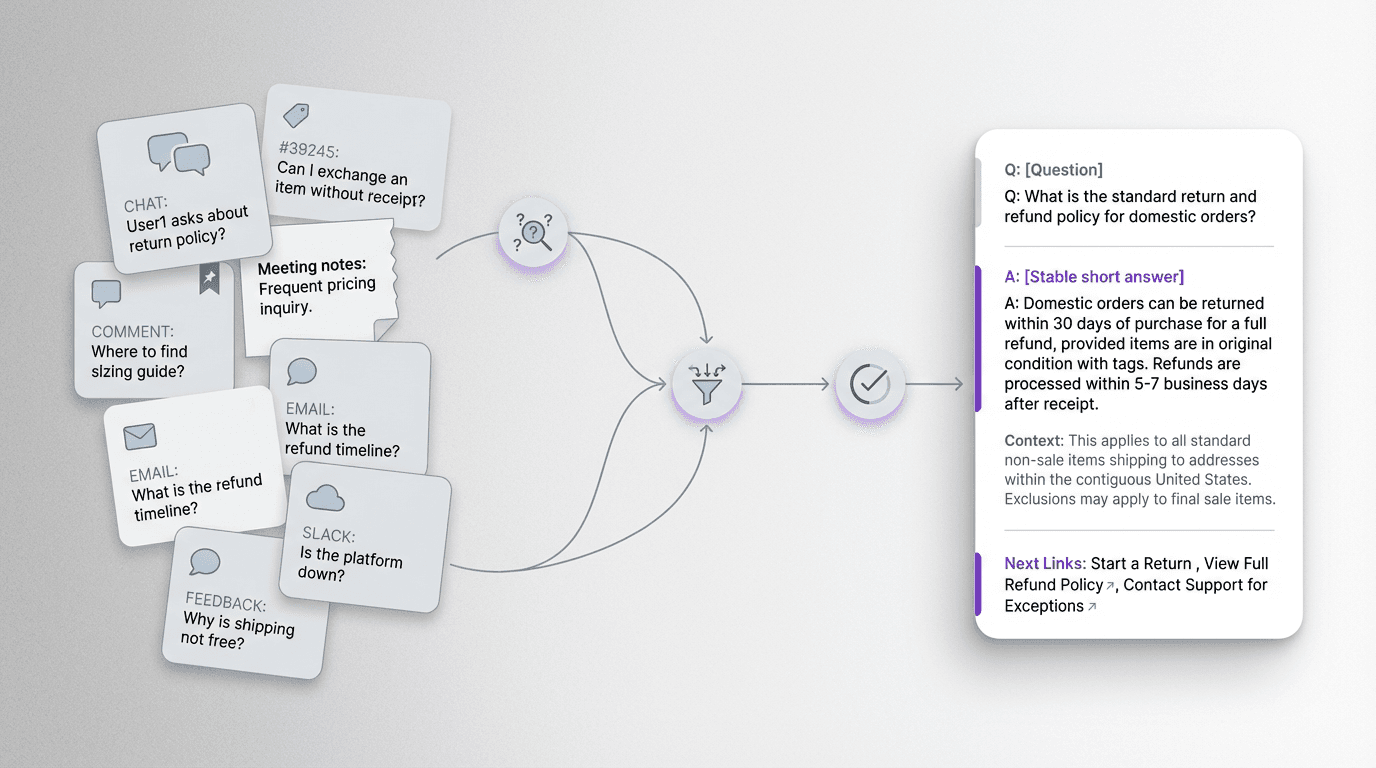
FAQ source material usually appears in the middle of work, not in a dedicated documentation session. Someone asks a question in chat. A request lands in a ticket queue. A teammate sends a quick note after a meeting. The useful move is to capture the question and rough answer while the pattern is still visible, then shape it into a cleaner, more stable entry later.
FormaLM helps rough answers settle into wording that stays clear, consistent, and reusable over time.
An internal FAQ template keeps answers consistent
Teams often treat an FAQ as a convenience page.
The list matters, but consistency matters more.
An internal FAQ is one of the clearest places where a team's operating language becomes visible. If the same question gets answered differently depending on who responds, the FAQ is not doing its real job yet. It is still acting like a loose note collection instead of a stable source of truth.
A good internal FAQ template stores questions and keeps the answers consistent.
A strong entry usually makes four things clear:
- what the question really is
- the direct answer
- any context or condition that changes the answer
- where someone should go next if they need more detail
If those parts are stable, the FAQ becomes reusable. If they are missing, the document may still look organized, but the team will keep rewriting the same explanation in different places.
What a useful internal FAQ template should include
A practical internal FAQ template is usually built from a small number of sections:
- question
- short answer
- fuller explanation
- exceptions or conditions
- linked source or related doc
- owner or team responsible
- last updated date
Most internal use cases do not need more structure than that.
The point is not to turn every answer into a long article. The point is to make the answer stable enough that another person can reuse it without improvising the missing parts.
Consistency matters most in knowledge bases used across support, operations, product, and marketing. Those teams often approach the same question from different angles. The FAQ template should keep that shared question from splitting into several answer styles.
An internal FAQ template you can reuse
Here is a practical internal FAQ template for teams and knowledge bases:
Question
Write the question exactly as a teammate would ask it.
Short answer
Give the direct answer in one or two clear sentences.
Full explanation
Add the context needed for someone to understand the answer without asking a follow-up immediately.
Exceptions or conditions
Call out cases where the answer changes, depends on timing, or only applies in some situations.
Related links or source
Point to the policy, product doc, process page, or source material behind the answer.
Owner
Name the team or person responsible for keeping this answer accurate.
Last updated
Record when the answer was last reviewed or changed.
This format works because it keeps the FAQ compact while still giving the answer enough structure to hold up over time.
A filled example of an internal FAQ entry
The template becomes easier to use when the finished version is visible.
Imagine a startup team building an internal knowledge base for product, support, and operations.
Question
When should we treat a customer request as a feature request instead of a support issue?
Short answer
Treat it as a feature request when the user is asking for a capability the product does not currently support, not when they need help using an existing workflow.
Full explanation
If the user can already complete the job with the current product, the issue usually belongs to support, onboarding, or documentation. If they cannot complete the job because the capability is missing, it should be logged as product feedback. When the answer is unclear, support should capture the request and include the user goal, current blocker, and any workaround already attempted.
Exceptions or conditions
If the issue looks like missing functionality but comes from permissions, configuration, or account state, it should stay with support until that is ruled out.
Related links or source
Support escalation guide, feature request intake process, product feedback board.
Owner
Support operations
Last updated
March 2026
The answer goes beyond yes or no. It gives people consistent language for a recurring decision.
Why internal FAQs often stay messy even with a template
The template is rarely the actual blocker.
The harder problem is that FAQ material usually starts as unstable source material.
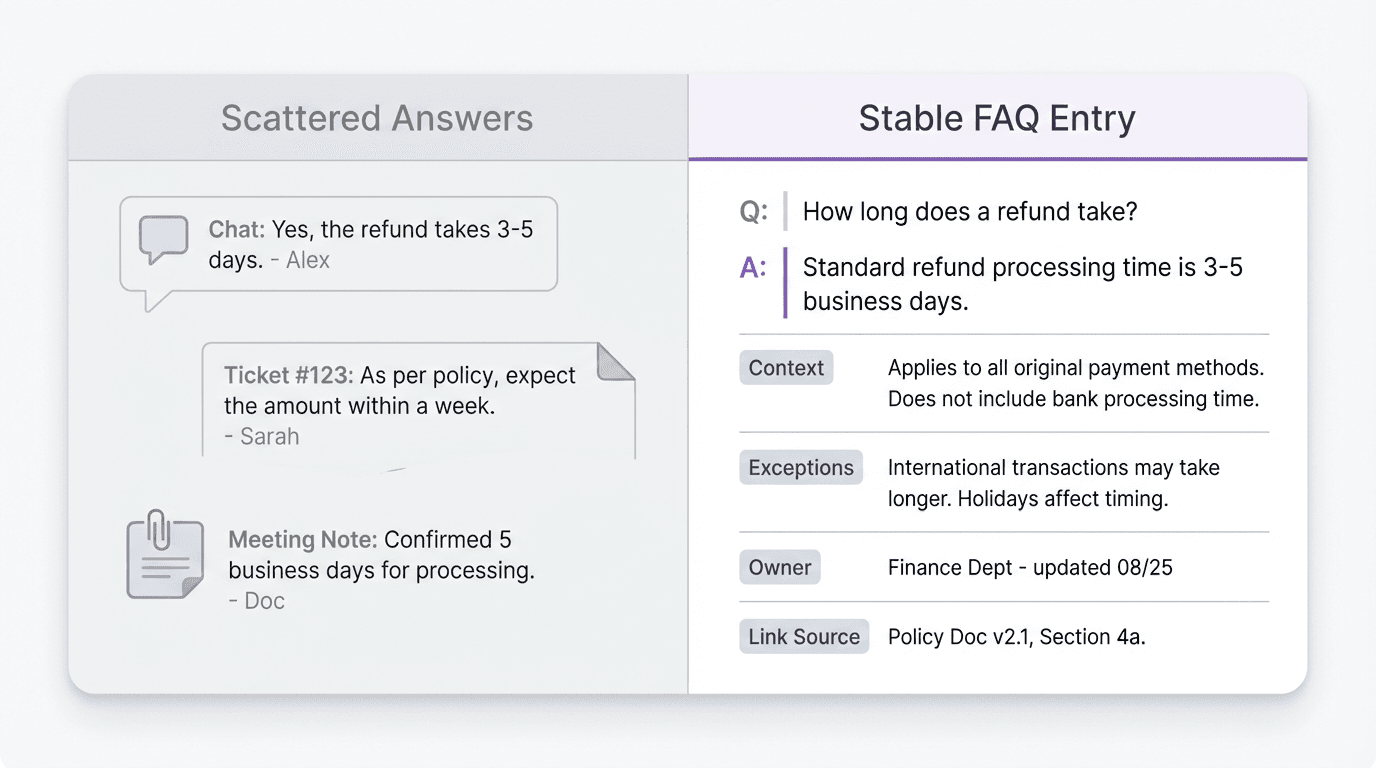
Questions arrive in different wording. Answers are partly implied. One person gives the short version in chat, while another adds nuance in a meeting, and a third person links a doc that answers only part of it. By the time someone tries to create the FAQ entry, the material is already spread across too many formats and tones.
Many internal FAQ pages look tidy but remain unreliable because the answers do not have clear owners or review dates.
The question exists. The answer exists. But the answer has not been compressed into a stable version yet.
That compression step matters more than teams often realize. Someone has to decide what the canonical wording is, what context belongs in the answer, what edge cases deserve mention, and what should stay outside the entry instead of bloating it.
Start FAQ capture where the question appears
Capturing questions at the source makes the FAQ easier to maintain.
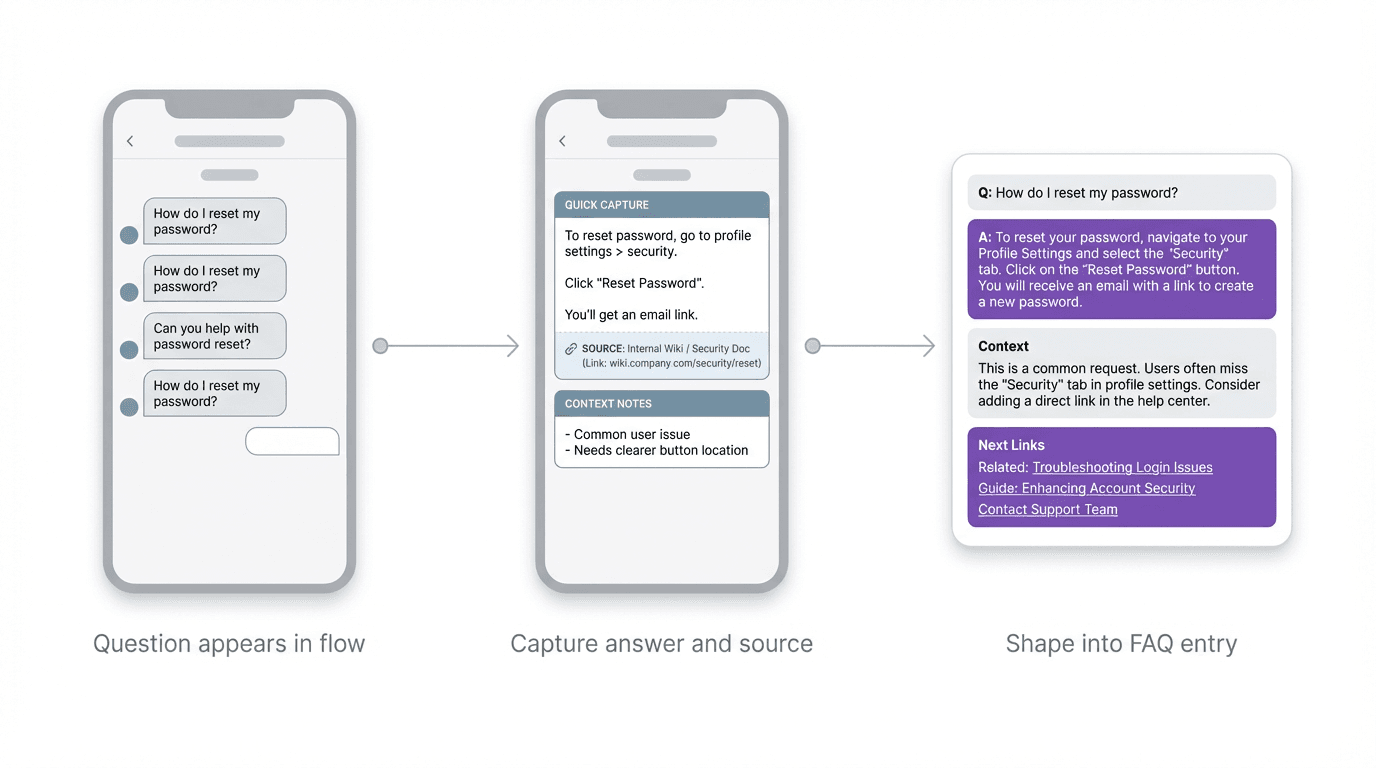
Do not wait until someone opens the knowledge base and decides to document everything later. Start when the same question shows up in the flow of work.
That may happen in:
- Slack or Teams messages
- support tickets
- onboarding questions
- internal meetings
- voice notes or quick mobile capture
An internal FAQ benefits from lightweight capture because the useful moment is often the first time you notice the question repeating, not the later moment when you finally clean up the knowledge base. If the team can preserve the question, the rough answer, and the likely source while that pattern is fresh, the final FAQ entry gets much easier to shape later.
FormaLM fits this step well because the job is already defined. You are not searching for what kind of content to make. You already know it should become an FAQ entry. The useful move is to capture rough input early, then press it into a version with stable sections and cleaner wording before it drifts again.
Keep the answer short first, then expand only where needed
One reason internal FAQ entries become hard to maintain is that teams over-explain too early.
The first responsibility of the entry is to answer the question.
That sounds obvious, but many internal FAQs bury the actual answer under setup, policy language, or process detail. A stronger template protects against that by separating the short answer from the fuller explanation. The reader gets the stable headline first, then the nuance only if they need it.
That makes the entry easier to scan. It also makes it easier to keep consistent as the knowledge base grows.
If the short answer keeps changing, the FAQ is unstable. If the short answer stays clear and the fuller explanation absorbs most of the nuance, the entry becomes easier to update without rewriting the whole thing every time.
When to split one FAQ into two entries
Another common problem is trying to make one FAQ entry hold too much.
This usually happens when a team notices that several related questions sit near each other and decides to force them into one long answer. That may feel efficient, but it often makes the entry harder to search, harder to link, and harder to maintain.
A better rule is simple: if two questions would require different short answers, they usually deserve separate entries.
That keeps each FAQ focused. It also improves reuse. People can link the exact answer they need instead of sending someone into a large blended entry and hoping they find the right section.
The template helps here too. Once each entry has the same structure, splitting one unstable answer into two cleaner ones becomes easier and less disruptive.
What makes an internal FAQ entry durable
The strongest internal FAQ entries usually share a few traits:
- the question sounds like something a real teammate would ask
- the answer starts directly instead of circling the point
- conditions and exceptions are visible
- the source or owner is easy to find
- the wording is stable enough to reuse elsewhere
That last quality matters most.
An internal FAQ lasts when it reduces answer drift. People trust it because the tone, scope, and meaning no longer change each time someone retells the answer. Over time, the knowledge base becomes more useful instead of remaining a partial archive of half-finished explanations.
An internal FAQ template helps most when it stabilizes team language
The best internal FAQ template helps repeated answers settle into a version the team can reuse. The raw material usually exists; it needs a format that makes each answer clear, consistent, and durable inside a shared knowledge base.
If the same question keeps appearing across chat, meetings, and tickets, the team probably does not need one more improvised answer. It needs a better path from rough answer fragments to a finished internal FAQ entry.