
Introduction
A good project brief template helps because it gives that material a clear shape.
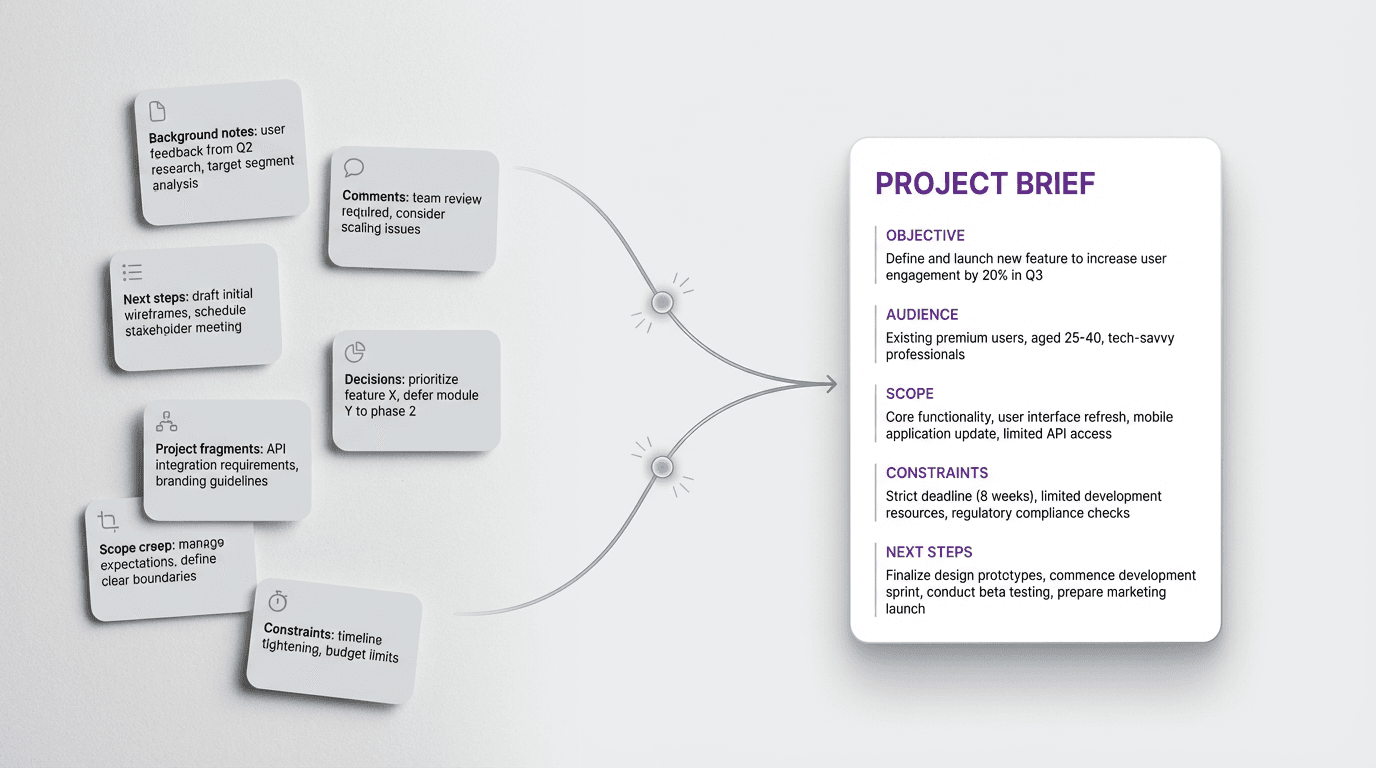
The template still needs a workflow for moving rough project logic into a concise finished brief. FormaLM organizes the background, conclusions, and next moves around the known format.
A project brief template aligns the team
Teams often treat the brief as paperwork that happens after the real thinking.
That framing is too weak.
A project brief is one of the clearest places where alignment either becomes visible or stays vague. It is the document that helps different people understand the same project in roughly the same way. That means the brief has to do more than record information. It has to establish focus.
A useful brief answers what the project is and:
- what the project is trying to achieve
- who it is for
- what constraints matter
- what decisions are already made
- what happens next
If the brief makes those things clear, the project usually moves more smoothly. If it does not, the team spends the next week reconstructing the same logic in meetings, comments, and side conversations.
What a useful project brief template should include
A strong project brief template is usually built around a small number of sections:
- objective
- audience
- project scope
- context
- key decisions
- constraints
- deliverables
- next steps
Not every brief needs all of them with equal weight, but most good briefs include some version of this set.
The point is not completeness for its own sake. The point is giving the reader a stable structure to move through.
Project briefs work best when the sections are direct. Each part should answer a real coordination question rather than occupy space because templates usually have that heading.
A reusable project brief template
Here is a practical project brief template that works well for internal projects, launch work, and cross-functional planning:
Project name
One clear line naming the initiative.
Objective
What should change or happen because of this project?
Audience
Who is this work for, and who needs it to succeed?
Context
What background does the team need in order to understand why this project exists now?
Scope
What is included, and what is intentionally outside the project?
Key decisions
What has already been decided so the team does not reopen the same questions?
Deliverables
What specifically needs to be produced?
Constraints
What timing, resourcing, technical, or approval conditions shape the work?
Next steps
What needs to happen immediately after the brief is shared?
This template works because it moves from purpose to boundaries to action. It gives the project a clear center before the team disappears into execution detail.
A practical example of a filled project brief
A project brief becomes much easier to understand when the filled version is visible.
Imagine a team preparing a homepage update for an upcoming product launch.
Project name
Homepage launch update for the new research summary workflow
Objective
Clarify the new workflow on the homepage so existing visitors understand what has changed and why it matters.
Audience
Current evaluators comparing FormaLM with more generic writing tools, plus returning visitors who have seen the older homepage positioning.
Context
For this hypothetical launch, the working assumption is that the product is easier to understand when the workflow is framed around shaping rough source material into finished outputs.
Scope
Homepage hero, supporting workflow section, and one example block. Pricing and onboarding pages are not part of this update.
Key decisions
The homepage should show how the product turns rough source material into finished content. The launch message should be aimed at teams working from notes, research, and internal drafts.
Deliverables
Updated homepage copy, revised section structure, and final approved design-ready content.
Constraints
The page needs approval from product and design by April 12. Existing analytics tracking should remain intact.
Next steps
Draft homepage structure, review with product, then move approved copy into design.
The document is short but specific enough to be useful.
Why project briefs often fail even with a good template
The main problem is usually not the template.
It is the compression step before the brief is written.
Project material often arrives in forms that do not map neatly into a brief. There are meeting notes, scattered comments, old docs, partial conclusions, and assumptions sitting in people's heads. When that raw material is poured directly into a template, the result often feels heavy or vague.
The brief gets longer, but not clearer.
A project brief can feel slow to finish because the writer has to decide what matters, what can be cut, what needs to be stated directly, and what belongs in the next steps rather than the background.
The better you get at that compression, the better the brief becomes.
How to get from rough project material to a finished brief faster
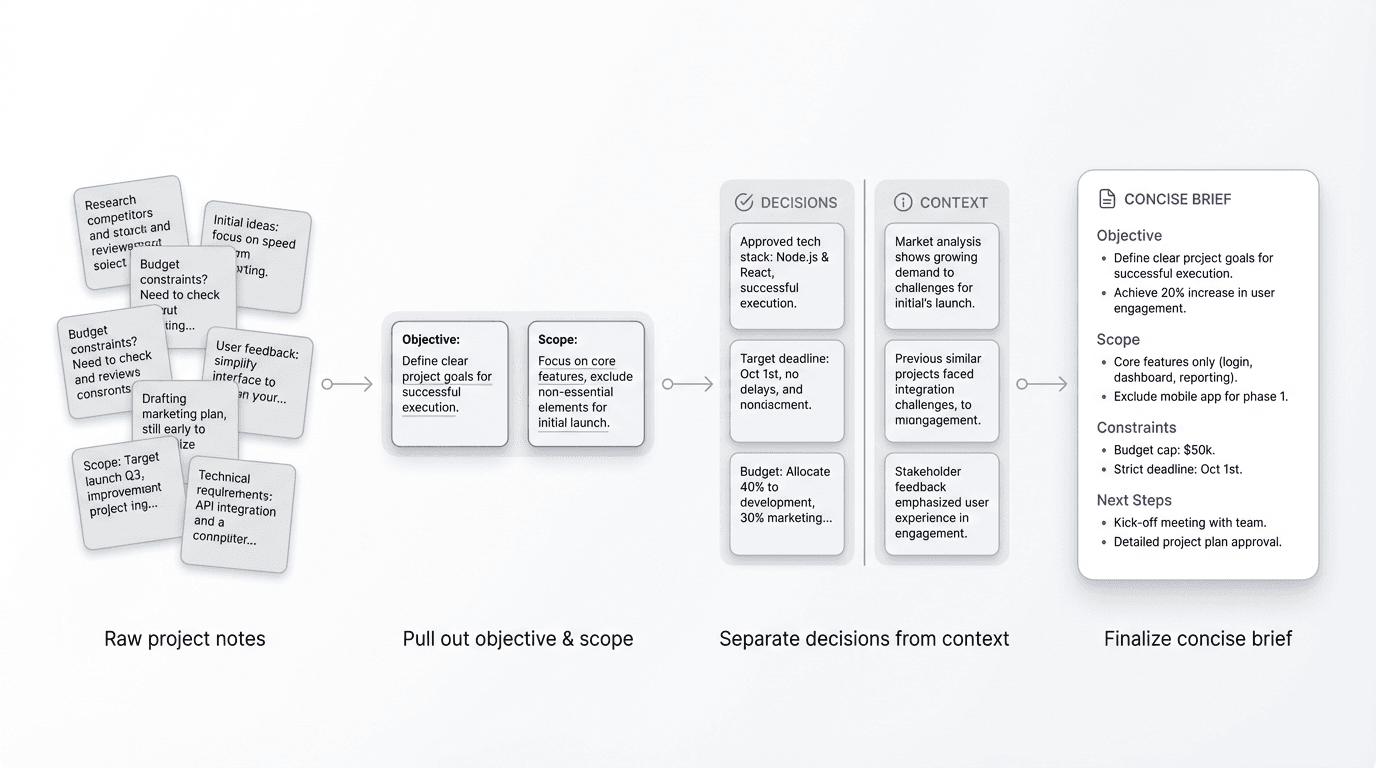
If you already know the output needs to be a brief, the fastest move is to shape the source material around that format early.
That usually means:
- pull out the real objective
- separate context from decisions
- define the scope line clearly
- identify the deliverables
- turn open discussion into visible next steps
Choosing the format early makes the remaining work easier.
You are not guessing what kind of document should exist. The document type is already chosen. The job is to compress the project into a cleaner version of that structure.
FormaLM fits project brief work because it helps turn project background, conclusions, and next actions into a concise version without making it empty.
The challenge is deciding what belongs, not polishing the prose.
When a one-page brief is better than a fuller document
Not every project needs a large planning document.
In many cases, a one-page brief is stronger because it forces sharper selection. It asks the team to decide what the project really is before the document expands around edge cases and background detail.
A shorter brief is often the better choice when:
- the team already shares most of the context
- the project scope is narrow
- the goal is alignment, not archival completeness
- the next step needs to happen quickly
The danger is not being brief. The danger is being unclear.
A one-page project brief works well when its sections stay concrete and the next steps remain visible.
What makes a project brief easy to read
The strongest project briefs usually share a few traits:
- the objective is stated plainly
- the scope line is visible early
- the decisions are not buried in context
- the next steps are explicit
These are simple qualities, but they matter because a brief is often read under time pressure. People are not reading it for literary quality. They are reading it to understand the project quickly enough to respond well.
Overlong briefs often lose value. They contain more information but create more interpretation work for the next reader.
The best brief is not the longest or most complete. It is the one that gives the team the clearest shared starting point.
A project brief template helps most when it leads to a finished result
Templates are useful, but only if they reduce friction in the real work.
That means the project brief template should do more than provide sections. It should help the team move from rough project material to a usable version of the brief that is concise, readable, and aligned enough to guide the next step.
A useful project brief workflow does more than fill sections. It produces a version another person can absorb quickly and act on with confidence.