
Introduction
NotebookLM is useful when the work starts with source material. You gather documents, ask questions, absorb the material, and try to get oriented faster. That is a real job, and it explains why the product is useful to so many researchers, students, operators, and knowledge workers.
But a lot of people searching for an alternative are already one step past that.
They do not only want to understand the material better. They want to turn the material into a result with a stable structure: a briefing, a recap, a comparison, an FAQ, a timeline, a decision memo, or another summary that feels complete enough to send, publish, or reuse.
That is the line that matters.
The best NotebookLM alternative for structured summaries is not necessarily the tool that looks most similar on the surface. It is the tool that is better at turning a known content need into a finished output shape without making you rebuild the structure by hand.
That is where FormaLM is worth looking at.
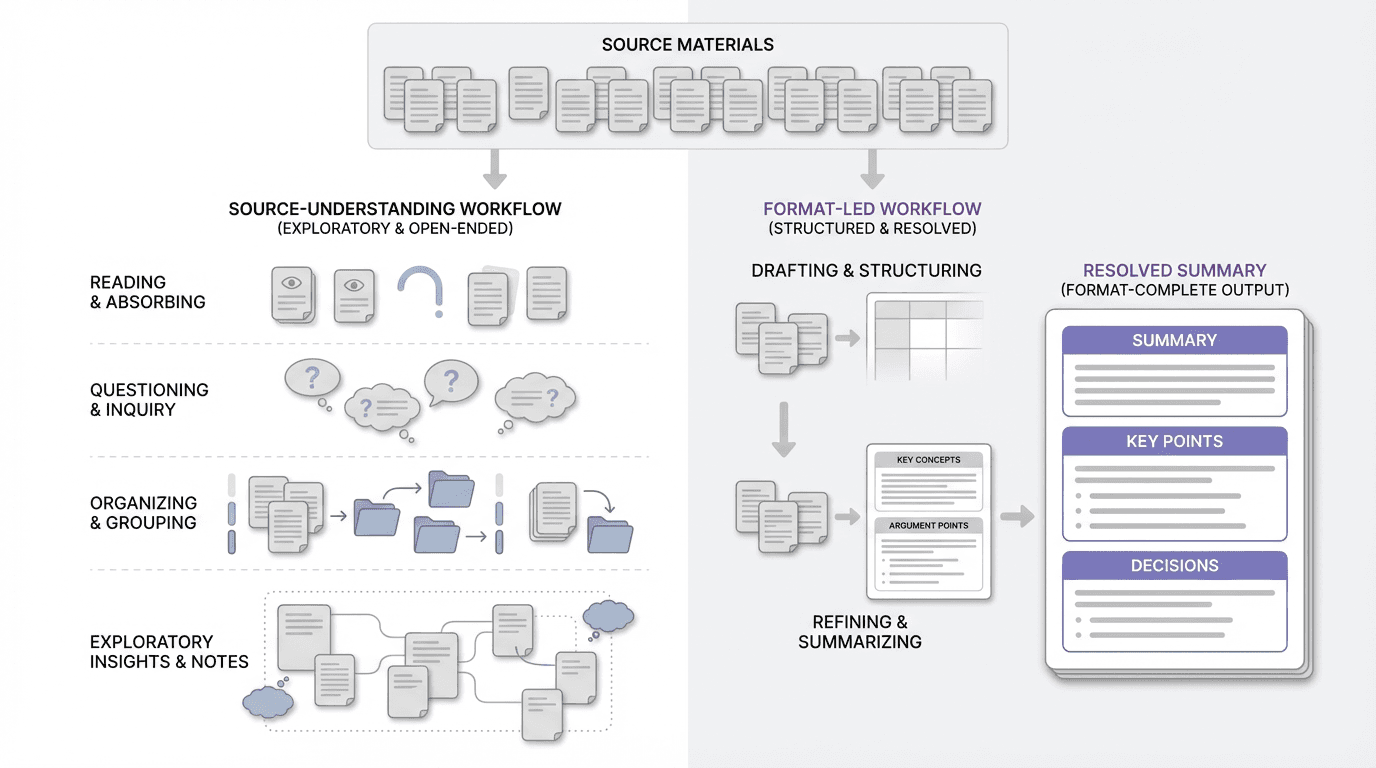
What people usually mean when they search for a NotebookLM alternative
The phrase "NotebookLM alternative" can hide two very different needs.
The first need is understanding. Someone has a set of documents, recordings, notes, or research materials and wants help reading, questioning, and organizing them.
The second need is completion. Someone already has enough material and wants to convert it into a summary that is shaped well enough to use in the real world.
Those workflows overlap, but they are not the same.
If your main friction is getting through source material, NotebookLM makes sense. If your main friction is turning that material into a clean output with predictable sections and a usable structure, the center of gravity changes.
That is why many alternative comparisons feel slightly off. They compare products as if they are all trying to solve the same moment in the workflow.
They are not.
NotebookLM is strongest when the job is understanding the material
NotebookLM is best understood as a source-grounded understanding tool.
It helps when you need to work through material, trace ideas back to sources, ask follow-up questions, and build orientation around a body of information. In that mode, its value is not mainly that it produces a polished artifact. Its value is that it reduces the effort of absorbing and navigating the input.
That makes it useful for cases like:
- reviewing dense research materials
- getting up to speed on a long set of documents
- asking grounded questions against a source set
- pulling out themes before deciding what to do next
This is why it can feel helpful early in a workflow. It gives the user a better reading surface and a better understanding loop.
But that does not automatically make it the best tool for the next stage.
Understanding the material and finishing the output are adjacent jobs. They should not be confused.
Structured summaries need more than material comprehension
A structured summary is not just a shorter version of the input.
It is a result with a shape.
That shape might be a project briefing with decisions and open questions. It might be a meeting recap with next steps. It might be a research summary with themes, implications, and recommendations. It might be a comparison that needs stable criteria and a conclusion.
In all of those cases, the user is not only asking, "What does this material say?"
They are also asking:
- what format should this become
- what sections need to exist
- what belongs in each section
- what can be removed
- what kind of finished result will be most reusable later
That is a different kind of assistance.
Once the output has to be stable, reusable, and immediately usable, the bottleneck is no longer only comprehension. It is format selection and completion quality.
This is where FormaLM is a different kind of alternative
FormaLM is not strongest when treated as a research notebook or a source exploration layer.
Its strength shows up later, when the user knows what kind of result they need and wants to get there with less drift.
Instead of centering the workflow on open-ended material interaction, FormaLM centers it on the target output.
That usually means moving from source material into one of a clearer set of finished formats, such as:
- a structured summary
- a decision memo
- a briefing page
- a recap
- a comparison
- an internal FAQ
- a timeline
The advantage is not that the system is trying to imitate a notebook.
The advantage is that it helps the work converge.
If NotebookLM is good at helping you stay close to the material, FormaLM is good at helping you turn that material into something you can actually hand off, circulate, or publish without a second round of structural rebuilding.
The real comparison is understanding workflow versus output workflow
This is the comparison most readers actually need.
Workflow 1: Understand the source material better
Best for:
- research intake
- source-grounded Q&A
- material review
- note organization
- getting oriented before deciding on an output
Main question:
"What is in this material, and how do I work through it faster?"
Workflow 2: Turn the material into a finished structured summary
Best for:
- team-facing summaries
- recurring recap formats
- briefings and decision documents
- reusable content outputs
- work that needs a stable structure, not just a helpful answer
Main question:
"What should this become, and how do I get to a finished version faster?"
That second workflow is where many users outgrow notebook-style tools.
Not because those tools are bad, but because the job has changed.
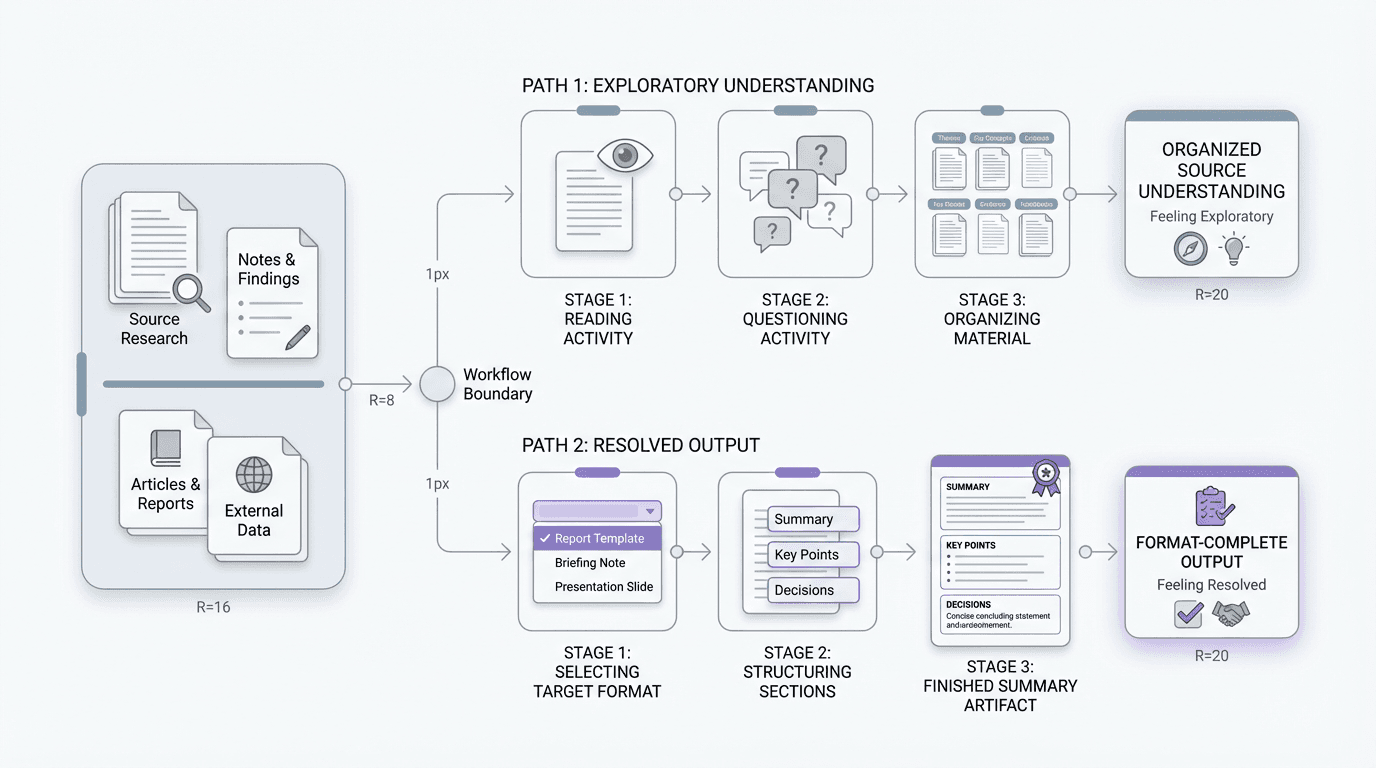
Where NotebookLM may still be the better fit
It is worth being precise here.
NotebookLM may still be the better fit if your work is still primarily upstream.
That usually means:
- you are still gathering and reading material
- you need source-grounded exploration more than output shaping
- you are not yet sure what the final deliverable should be
- you want a workspace for understanding before committing to a format
In those cases, trying to jump too early into a finished format can be premature. The material may still need to be explored before it can be compressed.
That is why this is not a hard replacement story.
For some users, NotebookLM is the right tool for the stage they are in.
Where FormaLM becomes the more useful alternative
FormaLM becomes more useful when the problem is no longer "help me understand this material" and has become "help me turn this into a result I can use."
That usually means:
- the input is already clear enough
- the deliverable is known or mostly known
- the summary has to follow a stable structure
- the output needs to be reusable across repeated workflows
- the result should feel finished, not provisional
This matters especially for operators, marketers, researchers, founders, and product teams who do the same summary work repeatedly.
In those workflows, the cost is rarely just reading time. The cost is having to reshape the same material into a usable format from scratch every time.
FormaLM is better positioned for that kind of work because it treats the output format as part of the solution rather than something the user has to invent at the end.
A practical way to choose between them
If you are choosing between NotebookLM and a tool like FormaLM, do not start by comparing surface features.
Start by locating the friction in your workflow.
If the friction is:
- reading
- source navigation
- grounded questioning
- material absorption
then NotebookLM is probably closer to the job.
If the friction is:
- deciding the output shape
- producing a stable summary format
- getting to a shareable or publishable result
- repeating the same summary workflow without rebuilding it each time
then a format-led tool like FormaLM is likely the more useful category.
That is the more honest way to think about "alternative."
Sometimes the best alternative is not the nearest clone. It is the tool that is better suited to the next job you actually need done.
The best NotebookLM alternative depends on whether you need understanding or a finished result
NotebookLM is a strong tool for understanding source material.
FormaLM is stronger when the work needs to end as a structured summary that already feels complete.
That is the boundary worth keeping clear.
If you want help reading, organizing, and questioning source material, NotebookLM may still be the right fit.
If you want more than understanding, if you want to turn material into a stable, format-complete result you can directly use, share, or publish, FormaLM is the more useful kind of alternative to try.