
Introduction
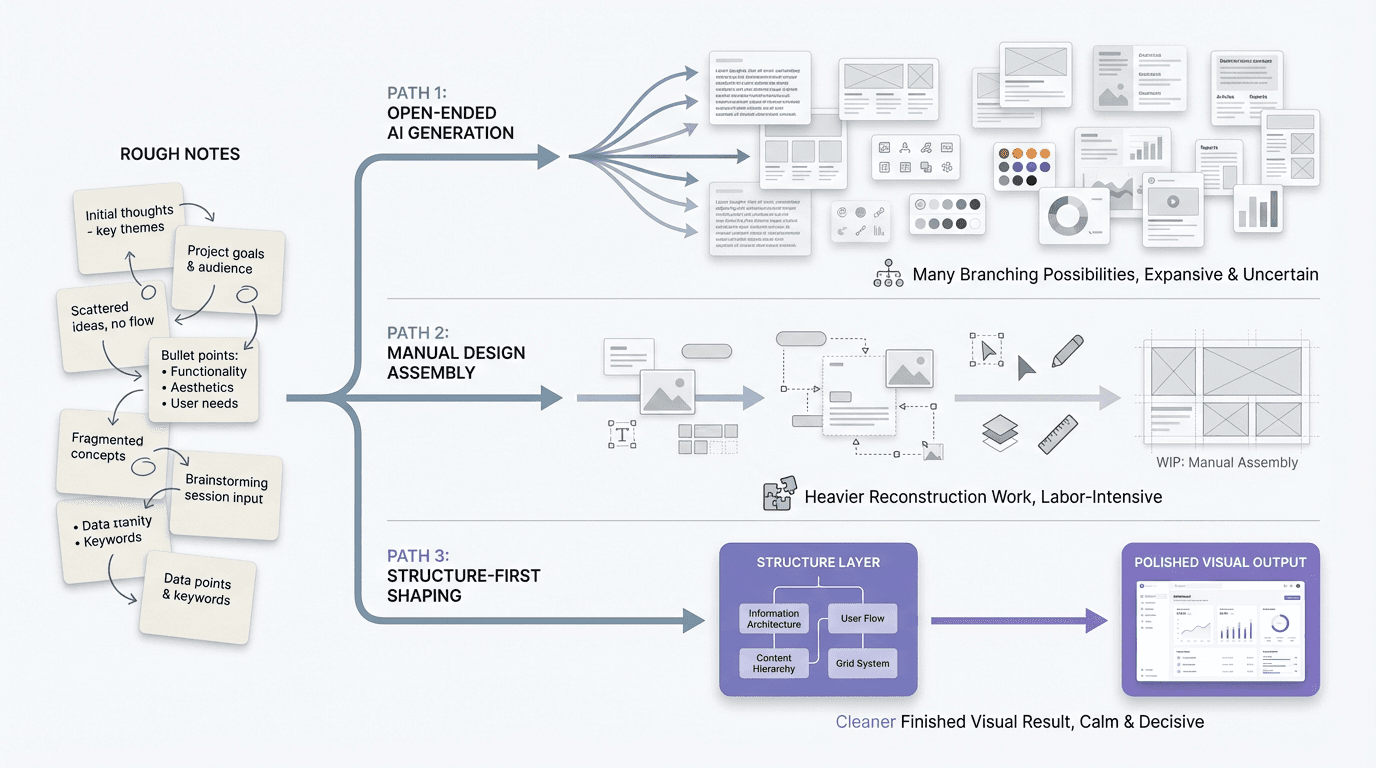
Many general AI tools can give you ideas, options, and rough layouts. Many design tools can help you style a polished visual once the structure is already clear. But there is a gap between those two moments, and that gap is where most notes-to-visual workflows slow down.
FormaLM is built to help rough material converge into a finished shape, with the format guiding the generation process.
What people usually mean by "notes into visuals"
The phrase sounds broad, but the job is usually one of a few specific things:
- turn notes into a carousel or slide sequence
- turn rough bullets into an infographic or one-page summary
- turn meeting or research notes into a visual recap
- turn scattered points into a structured comparison graphic
- turn draft thinking into something that can be shared without more reconstruction
Those are different outputs, but they share the same pressure point.
The user does not need a blank canvas. They do not need a chat system that can talk about the notes endlessly. They need a tool that can decide what the visual should be, what belongs in it, what gets cut, and how the information should be arranged so the result already feels coherent.
The category depends less on image generation than on giving the notes enough structure to justify a visual.
The bottleneck is choosing what the notes should become
General AI tools are often strongest when you want exploration.
You can paste in notes and ask for five angles, three formats, seven headline options, a lighter version, a more formal version, and a different framing for another audience. That flexibility is useful. It can help when you are still deciding what the material wants to become.
But exploration is not the same as completion.
If what you need is a usable visual output, too much openness can become drag. You get more possibilities than you need, but the burden of choosing, compressing, sequencing, and tightening still falls back on you. The model may sound capable, but the output often remains one step short of done.
This distinction sets the basis for the comparison.
The best AI tool for turning notes into visuals is not the one that gives you the most possible answers. It is the one that reduces the most editorial work between the notes and the finished artifact.
Three common tool types in this workflow
Most tools in this space fall into one of three patterns.
1. General AI chat tools
These are good at discussion, reframing, brainstorming, and rough transformation.
They help when the notes are messy and the user still needs help figuring out what kind of visual might make sense. They can suggest formats, summarize inputs, and produce first-pass copy quickly.
Their weakness is that the result is often still intermediate. You get text for a visual, ideas for a visual, or a rough outline of a visual, but not something that already feels resolved enough to use directly.
In other words, they are helpful upstream, but they do not always close the workflow.
2. Design-first visual tools
These tools are strongest once the content logic is already clear.
If you already know the headline, the sequence, the visual hierarchy, and the exact points that belong in the asset, design-first tools can turn that into a polished outcome. They give you layout control, styling choices, and presentational range.
But they are slower when the notes are still raw. Someone still has to act as editor. Someone still has to decide what the structure is. That means the visual workspace ends up carrying work that should have been resolved earlier.
3. Structure-first notes-to-output tools
FormaLM focuses on this conversion step.
A useful tool asks what the notes say and what they should become: a recap, comparison, short sequence, summary visual, decision page, or another clear format.
That shift matters because it narrows the work. Instead of treating notes as content to discuss indefinitely or design material to arrange manually, it treats them as raw input that should be compressed into a usable format fast.
This approach suits people who want to finish rather than keep exploring directions.
What makes a notes-to-visual tool useful
If the end goal is a visual result you would willingly use, four things matter more than raw AI range.
It should reduce the notes instead of restating them
Many weak outputs preserve too much. They keep the language of the notes, the repetition of the notes, and the unevenness of the notes.
A good tool should be able to cut aggressively enough that the result has hierarchy, pacing, and a visible point of view.
It should choose a format, not leave you with a pile of options
Flexibility sounds attractive until it becomes work.
If a tool keeps generating alternatives without helping the material settle into one, it extends the work. A useful product should help the content reach the format that fits the input.
It should move toward a finished artifact
The useful result is something a person would put into a team update, a deck, a post, or a shareable visual flow with minimal repair.
The output needs a useful format as well as clear language.
It should remove reconstruction work
Many tools produce material quickly but leave the user to rebuild it into a cleaner visual logic.
A stronger workflow removes that extra assembly.
Why FormaLM is better suited to this job
FormaLM is better understood as a get-it-done system than a generic AI playground.
Its advantage is not that it can imagine more directions than everyone else. Its advantage is that it helps ambiguous material settle into a usable result faster.
For notes-to-visual work, that means it is more likely to push the material toward:
- a tighter sequence instead of a loose list
- a structured comparison instead of scattered observations
- a one-page visual summary instead of an overlong recap
- a clear hierarchy instead of equal-weight bullets
- a finished-feeling draft instead of an exploratory draft
That product behavior matters.
Many people do not want to become the editor, strategist, and designer of a visual asset in three separate steps. They want a tool that helps the notes arrive in a state that already looks intentional. FormaLM is stronger when the job is to narrow, shape, and finish rather than endlessly elaborate.
Where generic AI tools still help
This does not mean general AI tools are useless in the workflow.
They can be very good when:
- you do not yet know what the notes should become
- you want broad idea generation first
- you need many alternate framings
- the output does not need to feel finished yet
They are especially helpful in the exploratory phase, when ambiguity is still desirable.
But once the user knows they need a visual result, the value shifts. At that point, it matters less that the model can produce many possibilities and more that the system can reduce ambiguity without losing meaning.
At that point, FormaLM becomes the more relevant tool.
Where design tools still matter
Design tools still matter after structure is resolved.
If the final output needs exact branding, custom visual treatment, detailed spacing control, or a high-fidelity presentation layer, a design workspace remains important. FormaLM does not replace that final step in every case.
What it changes is what arrives at that step.
Instead of carrying raw notes into a design file and solving the logic there, you bring in a cleaner, more intentional visual draft. That makes the design phase lighter and more predictable, which is often the real time savings.
So the comparison is not FormaLM versus design. It is FormaLM before design versus doing too much structural work inside design.
A practical way to compare tools for this job
If you are choosing the best AI tool for notes visuals, compare them using the actual workflow rather than their feature lists.
Ask:
- Does the tool help the notes commit to one strong format?
- Does the output already feel shaped enough to use?
- Does it reduce revision, or just produce a quick first pass?
- Does it help the information become clearer, or only more presentable?
- Does it get me closer to a visual I would send?
Those questions reveal more than a long matrix of features.
The useful tool is the one that removes the most uncertainty between the note pile and the finished asset.
The best AI tool for turning notes into visuals is the one that gets you to usable
The right workflow reduces cleanup by giving rough material structure, sequence, and enough finish to use. General AI tools can explore possibilities, and design tools can polish a resolved idea. FormaLM focuses on the movement between notes and a visual deliverable, helping the material reach a form worth keeping.