
Introduction
That is the more useful way to think about a retrospective template for startup teams. The goal is not to recreate everything that happened or to formalize the work so much that the team avoids doing it. The goal is to leave the project with one version of what mattered, what changed, and what should carry into the next cycle.
That is why retrospectives often become awkward in startups. Everyone agrees the learning is valuable. Almost nobody wants another heavyweight workflow after a launch, sprint, or cross-functional push. The work was already intense. The appetite for process is low. But if the team skips the retrospective entirely, the same mistakes and good decisions both disappear back into chat, memory, and scattered notes.
A useful retrospective template solves that exact problem. It makes the output clear enough to reuse without making the process heavier than the value justifies.
This is also why not every piece of work deserves a real content-production workflow. Many startup teams do not need polished retrospectives, decks, or full postmortem systems for every project. But retrospectives are one of the few internal outputs that often do deserve a stable format, because their value compounds. If the team can reuse the learning the next time around, the retrospective was worth doing.
That is where FormaLM fits well. The hard part is not inventing a new workflow category. It is taking rough project residue and pressing it into a retrospective that is actually reusable later, without forcing the team into a heavier system than it needs.
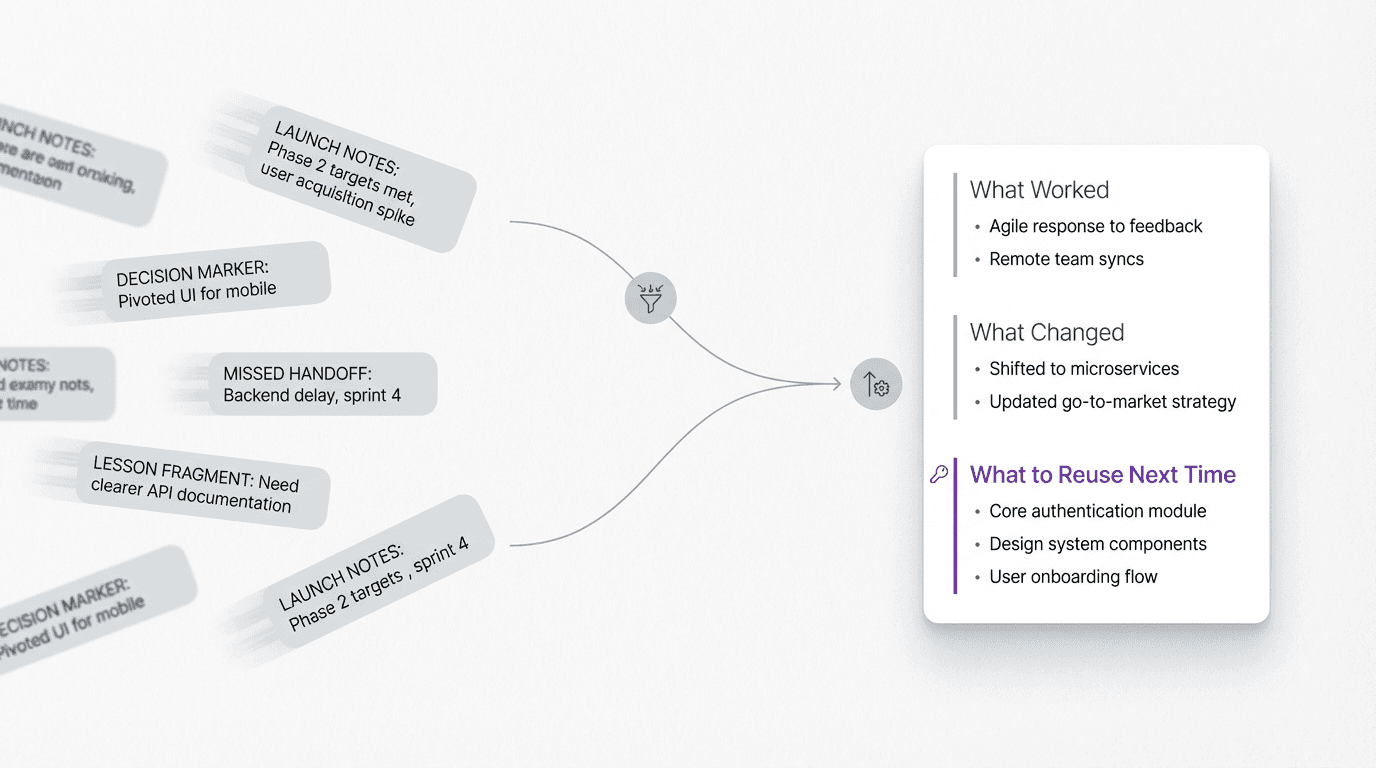
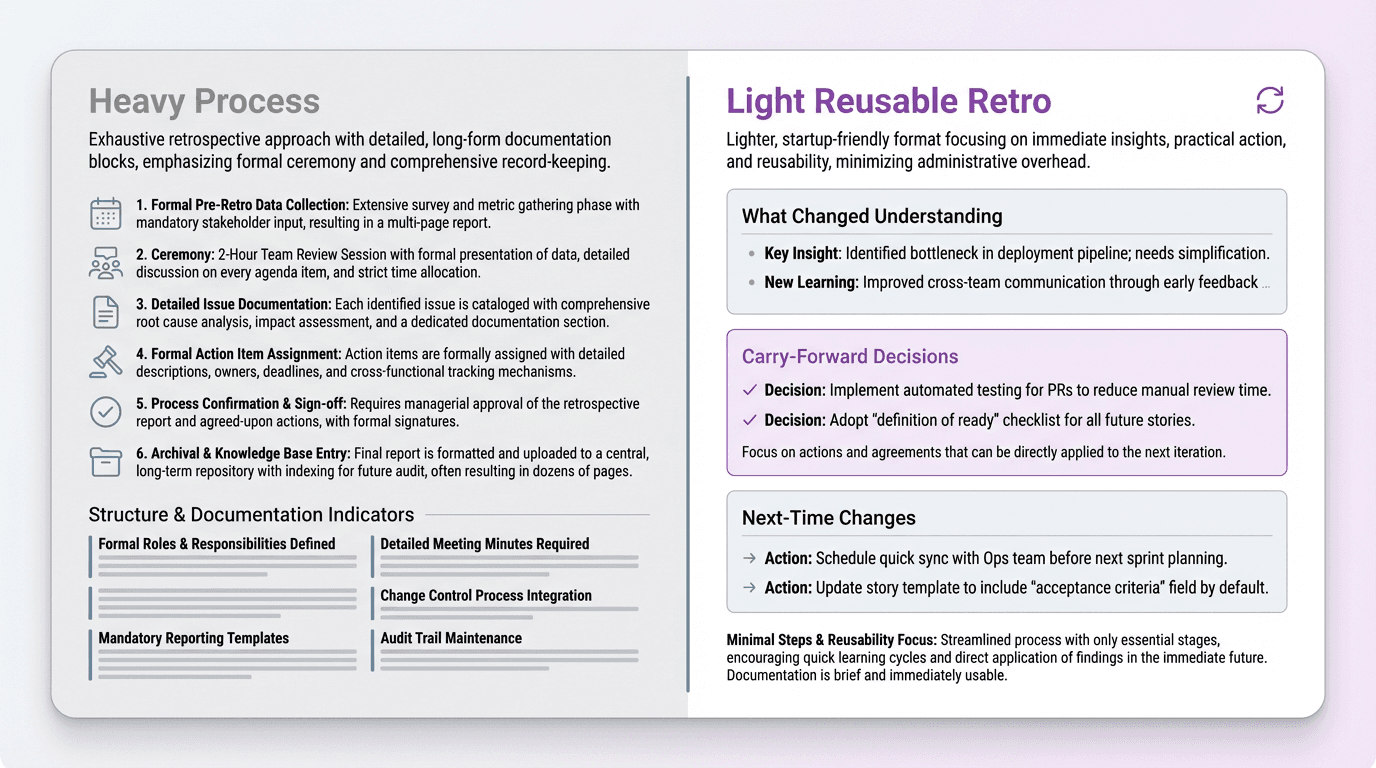
A startup retrospective should preserve consensus, not simulate ceremony
Many retrospectives become heavier than the team wants because they are modeled after a bigger process than the project actually needs.
That usually creates the wrong kind of friction.
The team is asked to reconstruct a full sequence of events, sort every issue, write exhaustive explanations, and document more than anyone will read later. The result may look thorough, but that is not always the same as useful.
For startup teams, the stronger standard is simpler. A retrospective should preserve the part of the project the team is likely to need again:
- what worked
- what created friction
- what changed in the team's understanding
- what should be reused next time
That is a consensus problem more than a documentation problem.
The retrospective earns its place when it helps the team leave with one clearer version of the project logic. If it only creates a longer record, it often feels complete without becoming especially reusable.
What a retrospective template for startup teams should include
A useful retrospective template for startup teams usually needs only a small number of sections:
- project or initiative
- original goal
- what worked
- what did not work
- what changed in our understanding
- what to reuse next time
- what to change next time
- owner or next follow-up
That is enough for most startup contexts.
The important thing is not the quantity of sections. It is whether the structure helps the team compress the project into something portable. A retrospective should not need a committee to finish. It should need just enough shape that the conclusions stop drifting.
That is why shorter templates often work better in startup teams than fuller postmortem formats. The team does not need to perform completeness. It needs to preserve the learning with low enough friction that it actually happens.
A retrospective template you can reuse
Here is a practical retrospective template for startup teams:
Project or initiative
Name the work clearly.
Original goal
What was the team trying to achieve?
What worked
What helped the project move faster, land better, or stay clearer?
What did not work
What created delay, confusion, rework, or weaker outcomes?
What changed in our understanding
What did the team learn during the project that it did not know at the start?
What to reuse next time
What should become a repeated part of the next workflow, handoff, or decision sequence?
What to change next time
What should be done differently on the next similar project?
Owner or next follow-up
Who carries this forward, and where will it show up next?
This format works because it keeps the retrospective close to the level of decision and reuse. It does not ask the team to produce a polished internal report. It asks for a usable carry-forward version.
A filled example for a startup launch retrospective
The template becomes much easier to use once the finished version is visible.
Imagine a startup team wrapping a product launch for a new onboarding flow.
Project or initiative
New onboarding flow launch
Original goal
Improve first-session activation by making the path to first useful output clearer.
What worked
Design and product aligned early on the core user path. Support was briefed before release. The launch checklist made dependencies more visible than usual.
What did not work
Lifecycle email approval happened too late. Analytics naming shifted during execution. Messaging decisions stayed open longer than the team expected.
What changed in our understanding
The team learned that message hierarchy needed to be locked before visual polish, not after it. It also became clear that support content should be treated as part of launch readiness rather than trailing documentation.
What to reuse next time
Use one launch brief shared across product, lifecycle, support, and analytics. Review dependencies one week earlier. Brief support before the final release week.
What to change next time
Lock messaging decisions earlier. Move lifecycle approval into the core timeline instead of treating it as a last-mile step.
Owner or next follow-up
Product lead updates the launch brief template and adds an earlier dependency review to the next release plan.
This is not a full postmortem. It is a lighter retrospective with enough structure to leave behind something useful.
Why startup teams avoid retrospectives that feel too heavy
The resistance is usually rational.
After a demanding project, most teams do not want to enter another process that feels like a second version of the work. If the retrospective requires too much formatting, too much recall, or too much administrative effort, it starts competing with the next priority instead of supporting it.
That is why many startup retrospectives either never happen or happen once and then disappear.
The team feels the value in theory, but the workflow asks for too much energy relative to the immediate payoff.
This is also why not every internal output deserves a full production system. Many pieces of internal work should stay light. They are useful in the moment, but not important enough to justify a repeatable content workflow. A retrospective is different because it often carries forward into future decisions. It has enough value to deserve a stable format, but usually not enough value to justify heavy tooling.
That middle zone is important. The retrospective should feel lighter than a formal postmortem, but more reusable than a few closing notes in Slack.
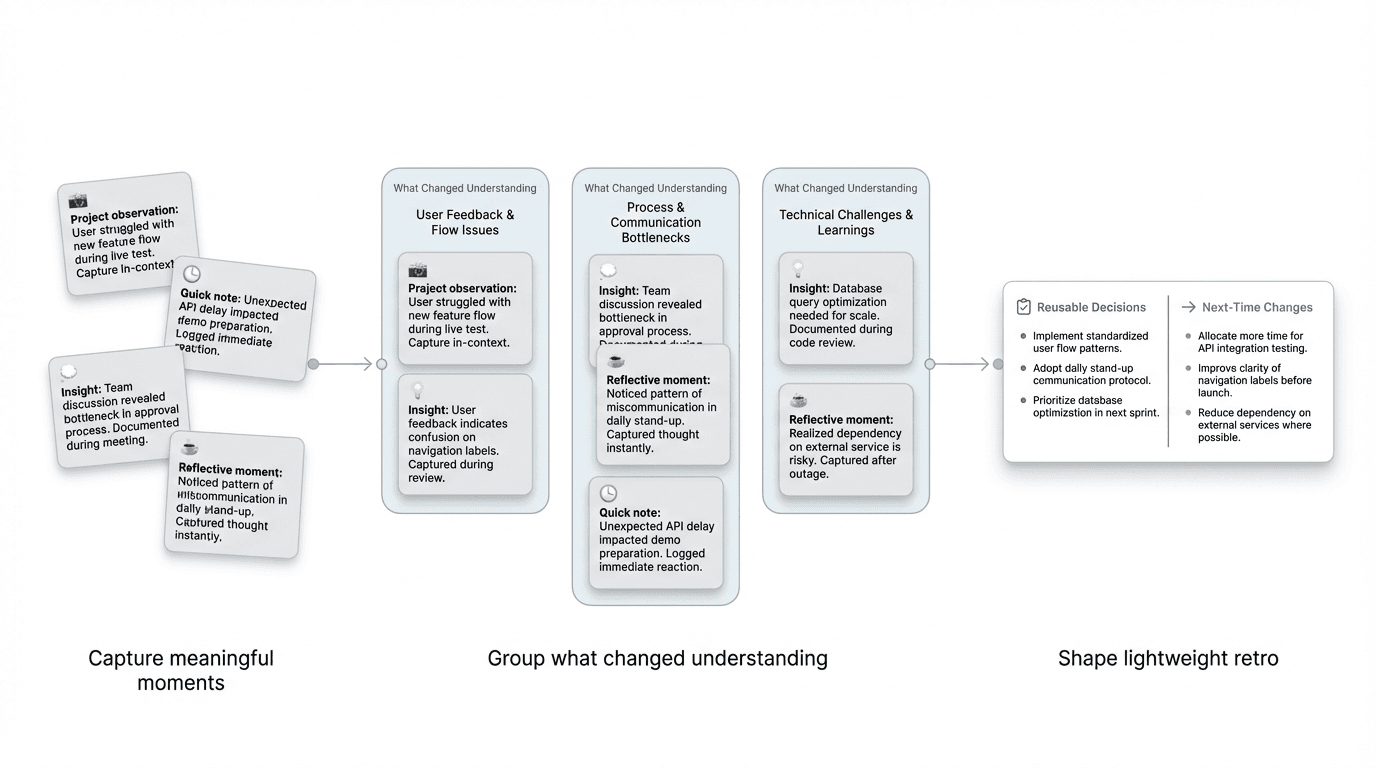
Start with the moments that changed the team’s understanding
When a startup team tries to write a retrospective from zero, the work can feel larger than it needs to be.
The easier move is to start with the moments that actually changed the team's understanding.
Those are usually easier to spot than the full chronology. A handoff that broke. A review sequence that helped. A decision that came too late. A step that turned out to matter more than expected. Those are the pieces that usually deserve to survive into the retrospective.
This is also where a mobile-first capture habit helps. The useful material often appears during the project, not only after it. Someone notices a failure point in chat. Someone says in a meeting that the next launch should never do it this way again. Someone leaves a note right after a review. If those moments get captured in a lightweight way while they are still fresh, the final retrospective gets easier to finish later.
FormaLM is well suited to this because the work is already format-shaped. You are not trying to invent a broad document from scratch. You are taking project residue that already points toward a retrospective and helping it settle into something clearer and more reusable.
What makes a retrospective reusable next time
The strongest startup retrospectives usually share a few traits:
- they stay close to the actual project goal
- they separate friction from interpretation
- they record what changed the team's understanding
- they name what should be reused, not just what went wrong
That last point matters a lot.
Many retrospectives over-index on failure because failure feels easier to notice. But a startup team also needs to remember what worked well enough to keep. Reusable learning is not only about avoiding mistakes. It is also about preserving good sequences, better briefs, cleaner approvals, and handoffs that reduced friction.
A retrospective becomes a content asset when it can help the next project start with a slightly better shape than the last one.
When a very short retrospective is the better format
Not every startup project deserves a large retrospective entry.
Sometimes the best version is a very short one.
That is usually true when:
- the project scope was narrow
- the team already shares most of the context
- the main value is preserving one or two carry-forward decisions
- the next related project will happen soon
In those cases, the retrospective only needs to hold the part worth carrying forward. It does not need to simulate a bigger operating system than the team actually uses.
A shorter format is often the reason the retrospective gets done at all. And a short retrospective that gets reused is worth much more than a perfect one that never leaves draft state.
A retrospective template for startup teams works best when it leaves behind a reusable asset
For startup teams, the value of a retrospective is not in proving that reflection happened.
It is in making the next similar project slightly easier, slightly clearer, and slightly less likely to repeat the same avoidable friction.
That is why the template matters. It gives the team a lighter path from rough post-project residue to one reusable version of what should carry forward. And that is why the workflow matters just as much. If the process is too heavy, the learning never settles into a form anyone will use again.
FormaLM fits that middle ground well. It makes it easier to turn a retrospective into a real content asset without forcing startup teams into a heavier knowledge workflow than the work deserves.