
Introduction
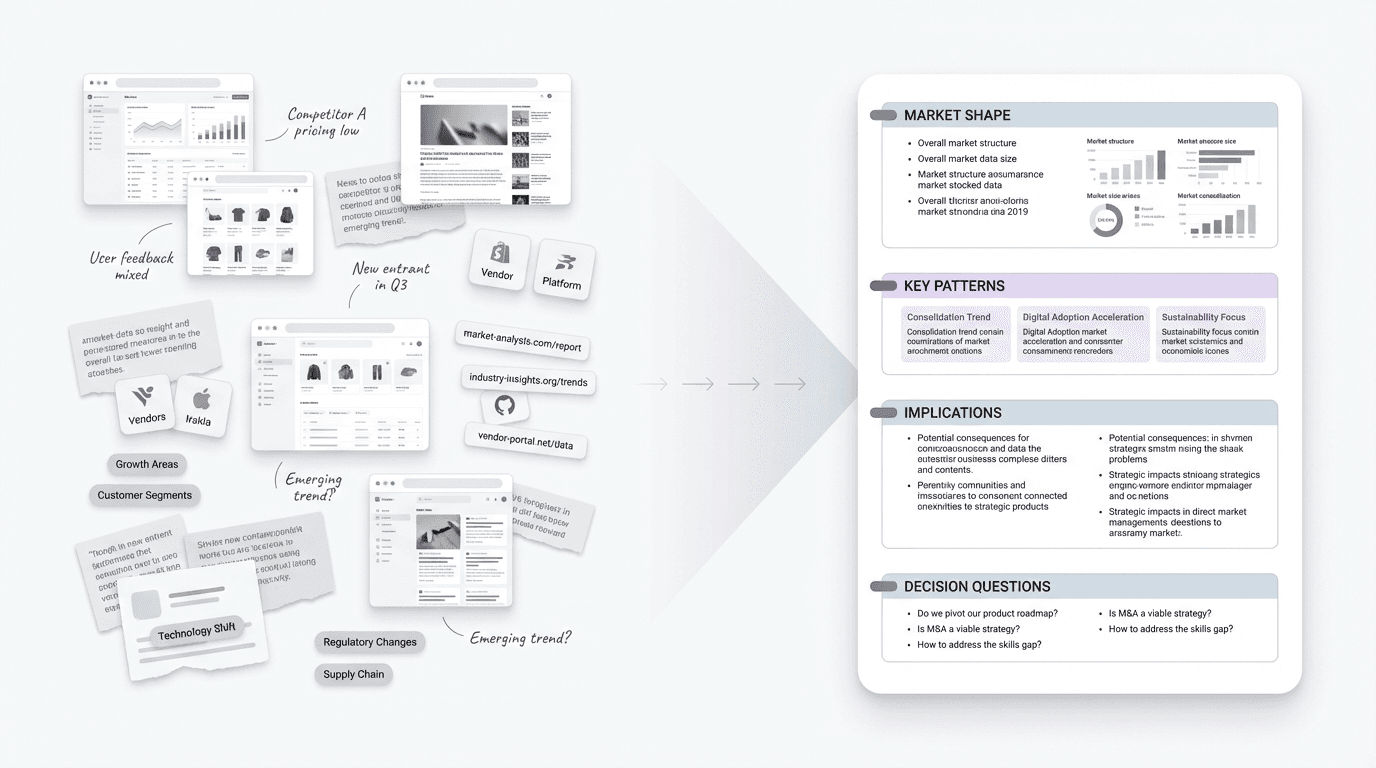
Each case follows the same basic workflow: gather scattered inputs, reduce noise, preserve the useful signals, and prepare a version that supports the next decision.
FormaLM lets teams start with rough inputs, answer the questions they know, and turn them into a stable, decision-ready scan without rebuilding the task in another workflow.
A market scan template is for orientation, not exhaustive coverage
A market scan should help a reader understand the current shape of a space quickly enough to form judgment: what is changing, which patterns are visible, who matters, what seems overhyped, and which questions need deeper work.
Useful scans are often lighter than expected.
If the scan tries to cover the whole category in equal detail, it becomes slow to produce and hard to reopen later. If it stays too loose, it becomes a pile of links with no decision value. The right middle state is a format that gives the background just enough structure to become usable.
Why market scans often fail even when the research is good
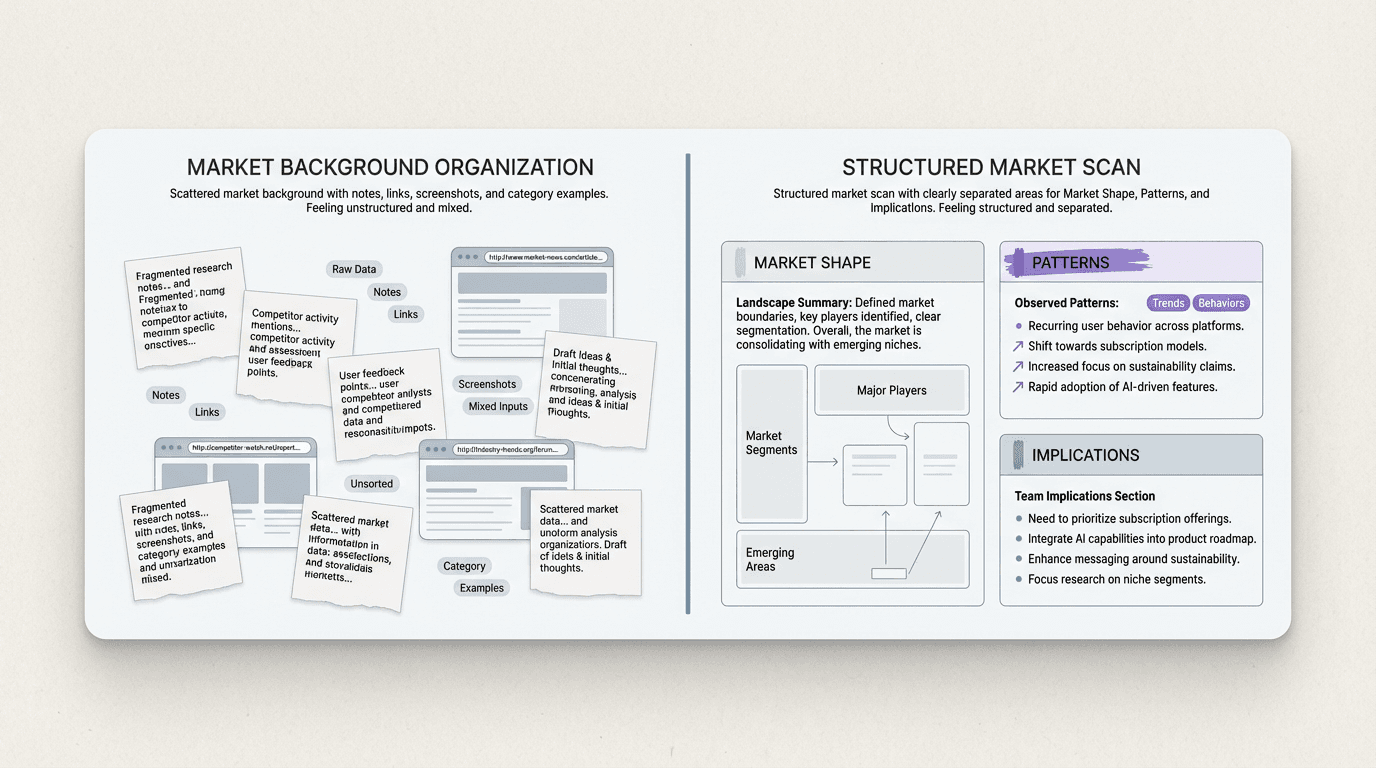
By the time someone starts writing the scan, they may already have screenshots, competitor pages, product notes, analyst links, internal comments, and rough judgments collected across a week. The problem is that none of those inputs yet behaves like a stable document.
The research and useful thoughts may already exist, but the team still needs one coherent version. The workflow matters as much as the template.
The source material often appears in fragments throughout the week. A note after a call. A screenshot from a vendor page. A quick read on category language. A pricing pattern noticed between meetings. Catching those signals and placing them into a rough scan structure early makes the final review much lighter.
What a useful market scan template should include
A practical market scan template should make the document legible without making it heavy.
For most teams, these sections are enough:
- context or scan goal
- what we looked at
- market shape at a glance
- notable patterns or shifts
- relevant players or examples
- implications for our team
- open questions or next steps
Some scans may also want source links, confidence notes, or comparison criteria. But the base structure should stay compact.
The structure should move someone from raw background to clearer judgment without turning every scan into a formal report.
A market scan template you can reuse
Here is a practical market scan template:
Context
What decision, question, or category this scan is meant to support.
What we looked at
The sources, companies, products, hiring signals, messaging examples, or market materials reviewed.
Market shape at a glance
A short summary of how the space currently looks.
Notable patterns or shifts
What seems to be changing in positioning, packaging, features, language, distribution, or buyer expectations.
Relevant players or examples
The companies, products, or cases worth keeping visible.
Implications for our team
What this background suggests for product, messaging, hiring, operations, or planning.
Open questions or next steps
What still needs validating, deeper review, or follow-up.
This works because it shows what the scan must cover and where more research is still needed.
A filled example of a market scan
The template becomes easier to use when the target state is visible.
Imagine a founder and product lead scanning the AI note-taking and summary space before deciding how to sharpen product positioning.
Context
Understand how the category currently describes value, where differentiation is concentrating, and what framing gaps still exist for a tool focused on finished structured outputs.
What we looked at
Homepage messaging from eight products, pricing pages, onboarding flows, launch copy, comparison pages, and a small set of user comments about evaluation criteria.
Market shape at a glance
The category is crowded with tools that promise speed, summarization, and AI assistance, but many still describe the product as a faster drafting surface rather than a clearer route to finished usable output.
Notable patterns or shifts
- More products are moving from feature lists toward outcome-led messaging
- Speed claims are common, but completion quality is still described weakly
- First-result onboarding is getting more attention than deep workspace complexity
Relevant players or examples
- Product A is simplifying language around team outcomes
- Product B is emphasizing fast capture but not clear finish
- Product C is using stronger before-and-after framing for user value
Implications for our team
- There is room to position more clearly around turning rough input into finished output
- The category still leaves a gap between capture and completion
- Product messaging should explain the usable result as clearly as the AI speed
Open questions or next steps
- Compare onboarding promises against actual first-session product behavior
- Revisit homepage headline directions against the clearest category language
- Run a deeper scan on how teams describe output quality versus generation speed
This example is selective enough to scan and specific enough to support a real conversation.
The best market scans separate background from judgment
Scans become difficult to trust when they mix source material, observations, and conclusions.
A vendor page is background. A repeated phrasing pattern is an observation. A conclusion about what the market is optimizing for is judgment. A recommendation for the team is a decision-use layer on top of that.
Separate those layers so the reader can see the evidence, the interpretation, and the proposed response. The scan can then support a decision without overstating certainty.
Finish the market scan while the signal is still fresh
The useful signal often appears before the writing session.
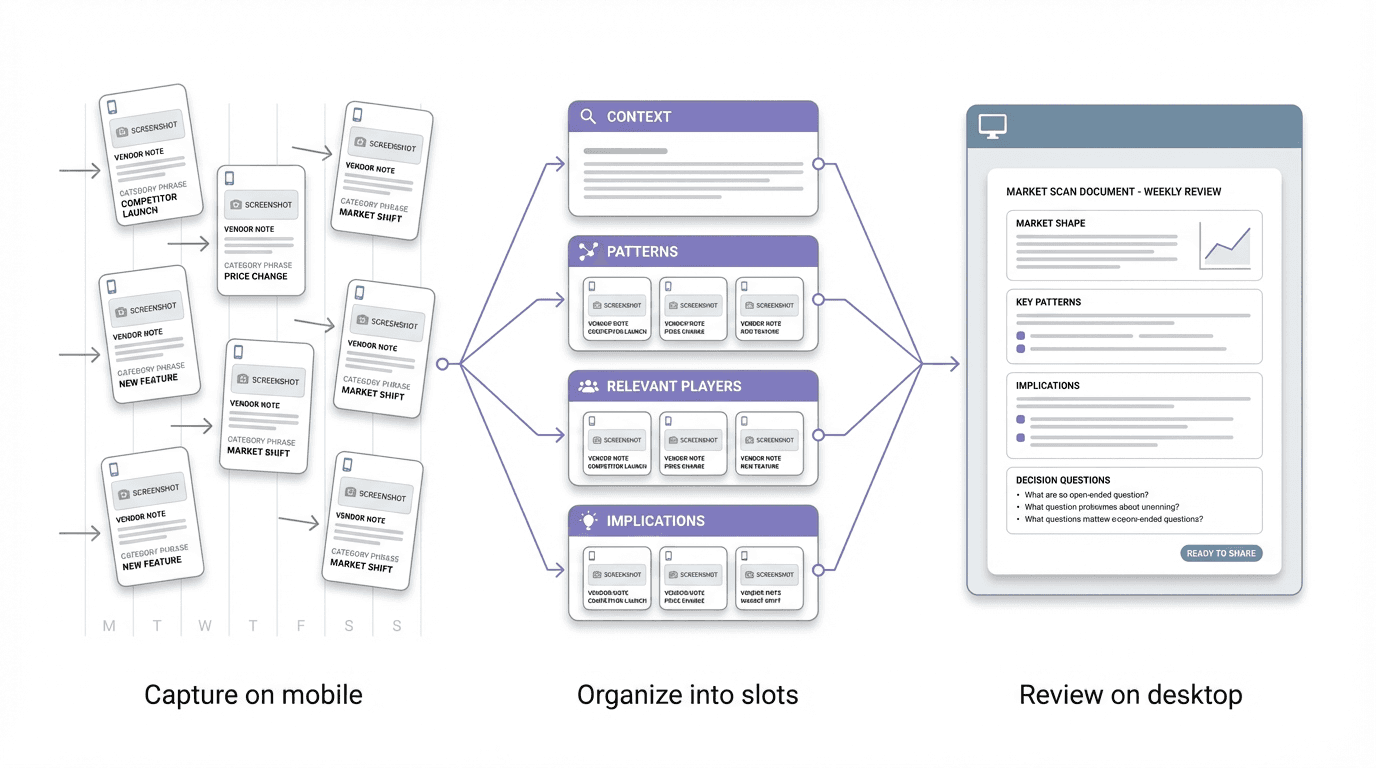
You notice a pricing pattern. You save a screenshot from a competitor page. You drop a line about a hiring trend into notes. You catch a repeated phrase in product messaging between meetings. None of that is the final scan yet, but all of it reduces the work later if it lands in the right rough slots.
A practical workflow is:
- capture useful signals when they appear
- place them into a recurring scan structure
- answer the focused questions that complete the scan and review the finished version
FormaLM is designed for this movement from fragments to a clear, reusable version that supports judgment and discussion. The same guided path is available on iPhone and the web.
A market scan is not the same as a competitor update or a strategy memo
These formats are adjacent, but they are not interchangeable.
A competitor update is usually narrower and more recurring. It tracks what changed and what to watch. A strategy memo is usually more interpretive and more committed. It argues for a choice or direction. A market scan sits between them. It is broader than a weekly update, but lighter than a strategic thesis document.
Keeping these formats distinct prevents the scan from becoming overloaded.
If it tries to become a strategy memo too early, it overstates certainty. If it behaves like a link list, it underdelivers on judgment. The stronger format keeps enough background to orient the team, enough interpretation to make the material useful, and enough restraint that the scan remains fast to produce.
A shorter market scan template often creates better decisions
A shorter scan often performs better because it keeps the document close to its real job: orientation for judgment.
This matters most when:
- the team needs quick context before a meeting or decision
- the category is moving, but not enough to justify a large research project
- the scan is a repeated workflow rather than a one-time strategic report
- the same people will revisit the document later and need to scan it fast
A strong market scan shows what matters now instead of displaying how much work went into it.
A market scan template works best when it turns rough input into decision-ready context
The harder part of a market scan is often compression rather than writing. Useful inputs already sit across notes, links, screenshots, pages, and rough judgments. They need a version that can travel into a meeting or message without the full research trail attached.
A stable template makes the scan directional without making it bloated. FormaLM helps turn that scattered background into a clear, usable version the team can judge and share.