
Introduction
By the time someone needs the weekly update, the material exists. What is missing is a stable version another person can scan and trust.
The task repeats often enough to need a format, but not enough to justify a heavy process every time. A full market report is too much. A chat dump is too little. What most teams need is a lighter recurring structure that helps the update become clear before it becomes forgotten.
FormaLM gives recurring competitor updates a stable completion mechanism. Material can accumulate throughout the week, then become one finished format through a few focused questions.
A competitor update template is a tracking format, not a market report
This distinction matters.
A competitor update is not trying to explain the whole market every week.
Its job is narrower.
It should help a team see what changed, why it may matter, what deserves follow-up, and what should stay on the watchlist. A broader market scan, strategy deck, or full competitor profile serves a different purpose.
The more clearly the format owns that role, the more useful the update becomes.
If the document becomes too large, it loses recurrence. If it stays too light, it loses interpretation. A strong competitor update template sits between those two failures. It keeps the update compact, but still gives the team enough structure to align around what matters.
Why weekly competitor tracking often turns into scattered residue
The material usually appears in pieces.
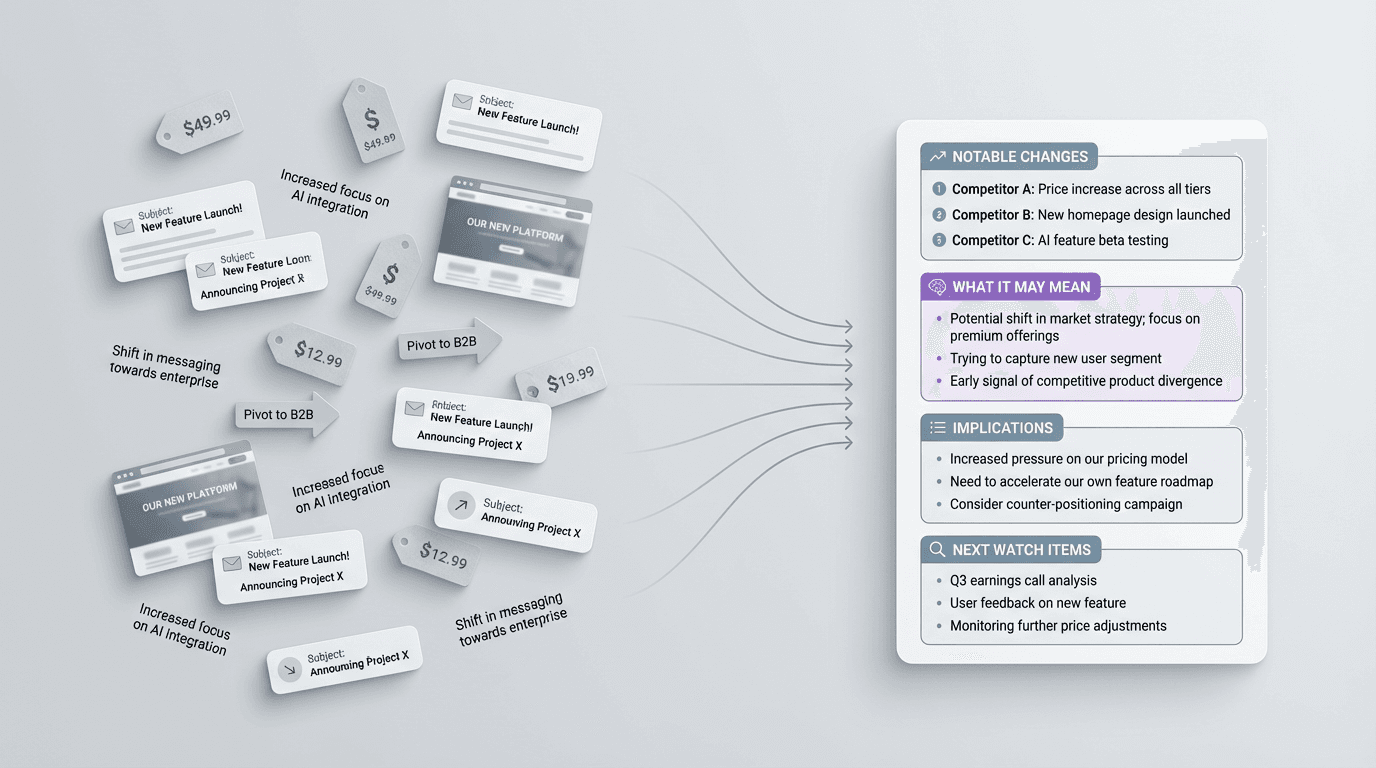
A product marketer notices a new headline. A founder forwards a screenshot. Someone in sales flags a pricing change. A teammate drops a launch email into Slack. Another person hears a claim in a call that sounds small at first, but starts to matter once it repeats.
None of that looks like a finished weekly update while it is happening.
Competitor tracking decays into residue when the team has signals but no format for turning them into one readable version.
A lightweight capture workflow preserves competitor material when the signal appears, then helps turn it into a finished update without reconstructing it later.
What a useful competitor update template should include
A practical competitor update template should stay light, but it should separate types of information clearly enough that the update remains scan-friendly.
For most teams, these sections are enough:
- week or date range
- notable competitor changes
- what those changes may mean
- patterns or themes worth watching
- implications for our team
- next watch items
Some teams may also want source links, owners, or confidence notes. But the core structure should not become heavy by default.
The update preserves what changed and why it matters.
The update should help the team tell the difference between what happened, what might matter, and what deserves attention next. Once those categories are separated, the update becomes easier to reuse and easier to trust.
A competitor update template you can reuse every week
Here is a practical competitor update template for weekly tracking:
Week
What period this update covers.
Notable changes
What changed in competitor messaging, pricing, product, launch behavior, or go-to-market activity.
What it may mean
Why these changes may matter, and what interpretation seems most plausible right now.
Patterns worth watching
Repeated signals, emerging themes, or movements that are not yet conclusive but should stay visible.
Implications for our team
What the team should consider, compare, test, or discuss in response.
Next watch items
What to keep tracking into next week.
This works because it keeps the format directional. It does not ask the team to preserve every detail. It asks them to turn a week's signals into one version that is usable.
A filled example of a weekly competitor update
The template becomes easier to use when the finished state is visible.
Imagine a product marketing team tracking three direct competitors over the week.
Week
April 1 to April 5
Notable changes
- Competitor A introduced a simpler pricing page with fewer plan comparisons
- Competitor B changed its homepage headline to emphasize finished output over raw generation speed
- Competitor C launched a short onboarding email series focused on first-week activation
What it may mean
- Competitor A may be reducing pricing friction for earlier-stage buyers
- Competitor B appears to be moving toward a more outcome-led positioning model
- Competitor C may be treating onboarding as a bigger conversion lever than feature breadth
Patterns worth watching
- More competitors are simplifying language around output quality and usability
- Activation and first-run value seem to be getting more attention than broad capability claims
Implications for our team
- Recheck whether our homepage still describes the product at the right level
- Compare current onboarding story against the stronger first-result framing in the market
- Keep watching whether simplified pricing language becomes more common
Next watch items
- Track whether the pricing simplification changes in-product upsell behavior
- Watch for follow-up messaging from Competitor B across email and sales pages
- Save onboarding examples from Competitor C for next week's review
Its compact scope makes the format sustainable.
The update is short enough to repeat and finished enough to make the week legible.
The best competitor updates separate observation from interpretation
Weekly tracking documents weaken when these categories blur.
They collapse everything into one undifferentiated list.
But a screenshot is not the same as a conclusion. A homepage change is not the same as a strategic pattern. A launch email is not the same as an implication for your own team.
Once those categories blur together, the update becomes harder to read and easier to overreact to.
A stronger competitor update template keeps the document honest:
- what changed
- what we think it may mean
- what still needs more evidence
- what our team should do with that information
That structure improves the update not because it is more formal, but because it keeps the team from confusing raw signal with finished judgment.
Build the update during the week, then finish it once
This workflow makes recurring competitor tracking lighter.
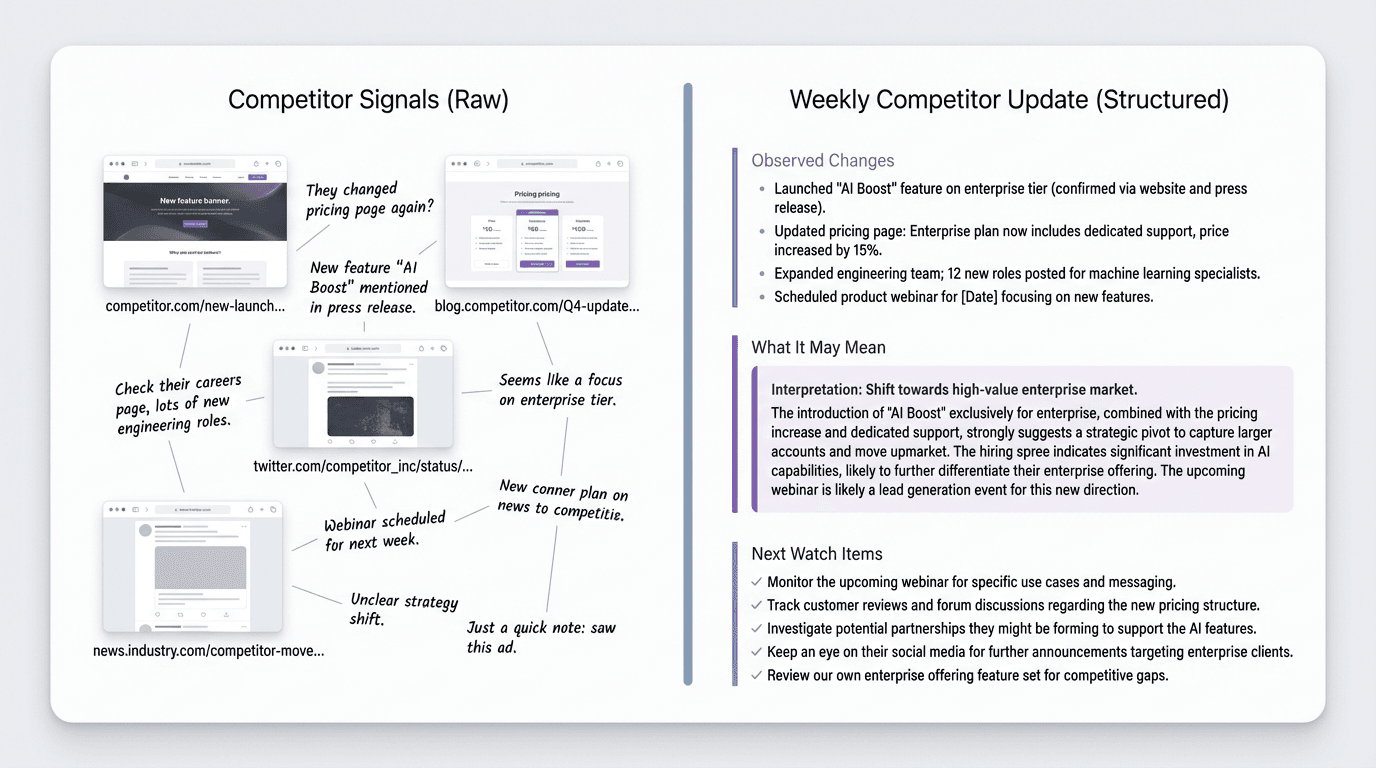
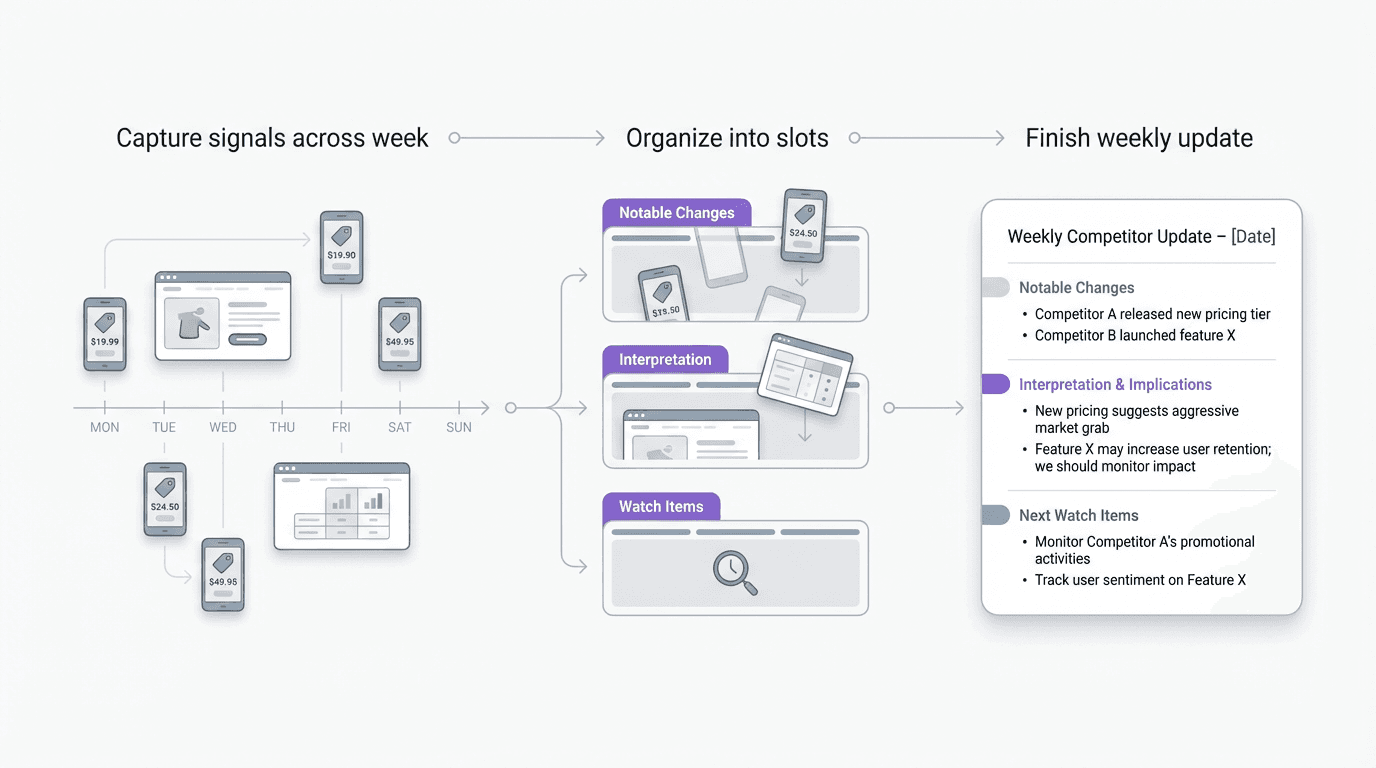
Instead of rebuilding the update from zero every Friday, collect signals in the rough sections they will eventually belong to.
That may mean dropping a screenshot into a notable changes slot, saving a quick interpretation note under what it may mean, or capturing a repeated market pattern before it disappears into chat history.
Then, at the end of the week, finish the document once.
That does two useful things:
- it reduces restart cost
- it keeps the final update closer to the moment the signal first appeared
FormaLM supports this middle ground: a task that repeats often enough to need structure but not a heavy content system.
A shorter competitor update template is often the better one
Many teams make the mistake of expanding the competitor update until it feels important enough.
Usually that makes it worse.
If the update takes too long, the habit degrades. If it asks for too much synthesis every time, the team stops finishing it consistently. If it over-explains each signal, people stop scanning it.
A shorter competitor update is often stronger because it protects the recurring motion.
A compact update works especially well when:
- the same team reads the update every week
- the market is active enough that continuity matters more than completeness
- the main goal is directional awareness, not exhaustive research
- the team already has deeper market documents elsewhere
In those cases, a smaller format is not a compromise. It is what keeps the update usable.
A competitor update is not the same as a battlecard or a full competitive analysis
These formats solve different problems.
A battlecard is usually decision-support for sales or positioning in a specific competitive context. A full competitive analysis asks for broader comparison, more evidence, and a more stable point of view. A weekly competitor update usually has a narrower job: preserve what changed this week in a way that helps the team stay oriented.
That distinction matters because it protects the format from becoming overloaded.
If the weekly update tries to do the work of a larger analysis, it becomes too heavy to sustain. If it only stores links, it becomes too thin to be useful. A recurring format can keep the week legible until the team needs deeper strategic work.
A competitor update template works best when it lowers weekly restart cost
A useful competitor update template creates a recurring mechanism for signals that arrive in fragments. It keeps the update compact enough to finish consistently and turns scattered market activity into one usable weekly view.
FormaLM provides that stable format, so the team does not have to reorganize the material from scratch each week.