
Introduction
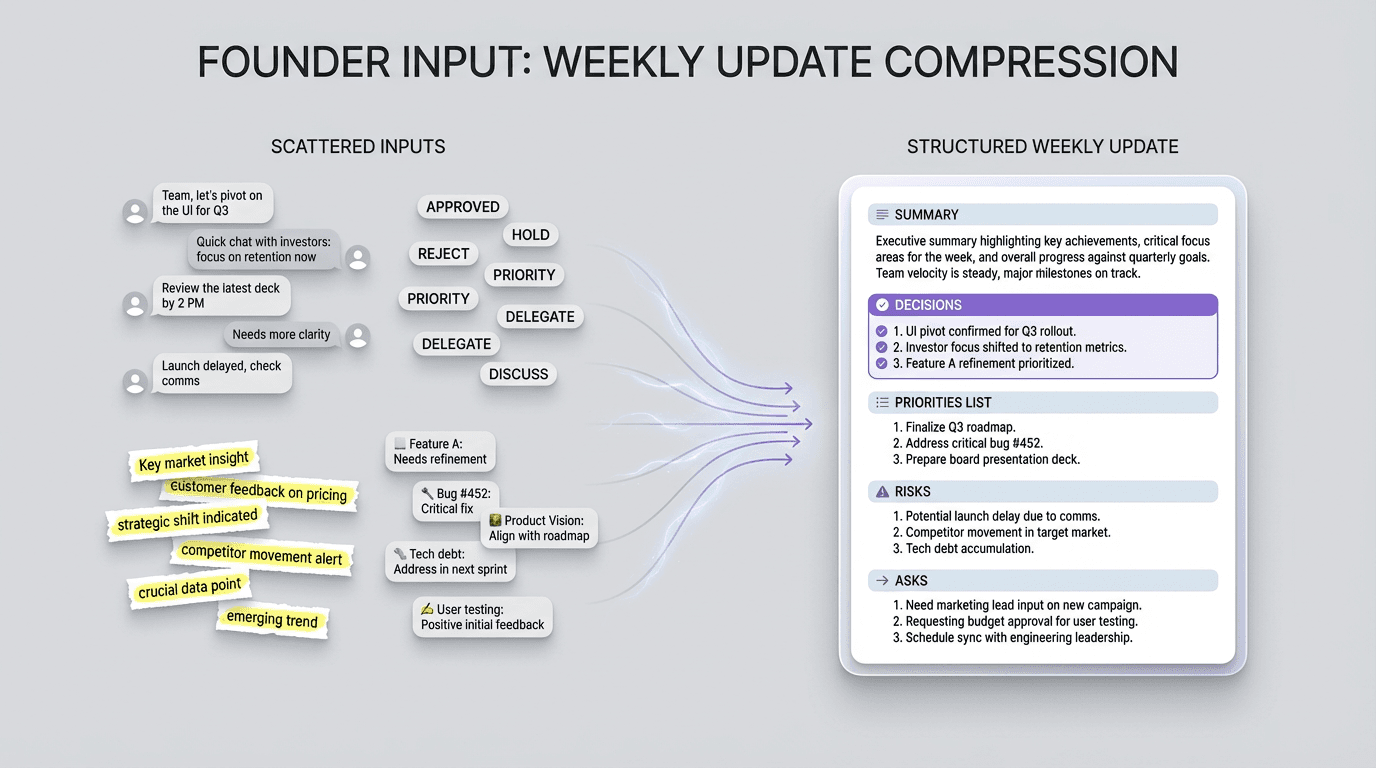
For founders, the difficulty is usually not idea generation. It is compression. Can the thinking become a clear weekly version before it gets diluted across chat threads, memory, and half-finished notes.
FormaLM helps founders start with the inputs they have, answer focused questions, and shape them into a compact update the team can align around.
A founder weekly update is a team alignment tool, not a diary
This distinction matters.
A founder weekly update is not mainly a personal reflection exercise. It is not a long memo about everything the founder touched that week either.
Its job is narrower and more useful.
It should help the team understand what the founder is seeing, where priorities are moving, which decisions are becoming clearer, which risks deserve attention, and what the company should do next. The best template turns that judgment into a shared update instead of logging activity.
If the update becomes too personal, it turns vague. If it becomes too operational, it turns into a status dump. The useful middle is a short document that captures founder signal in a form the team can use.
Why founder updates often stay trapped in chats and mental notes
Founder thinking rarely appears in one clean drafting session.
It shows up across the week in compressed moments:
- a reaction after a sales call
- a change in conviction after reading a market note
- a product concern raised in a team thread
- a sharper take on positioning while walking between meetings
- a quick answer in chat that quietly changes direction
None of these moments looks like a finished update on its own. But together they often contain the week's most important operating judgment.
Founder updates go missing because the raw material remains distributed. The founder remembers the conclusion while the team sees only pieces of the path.
The template helps because it creates a place where those fragments can settle into a stable shape.
What a useful founder weekly update template should include
A good founder weekly update template should stay compact, but it needs enough structure to make the thinking legible.
For most founder-led teams, these sections are enough:
- week or date range
- company-level summary
- what I am noticing
- decisions or direction changes
- priorities for the coming week
- risks, blockers, or concerns
- asks for the team
That structure works because it separates different kinds of founder input.
Observations are not the same as decisions. Priorities are not the same as risks. Asks are not the same as a recap of what happened. Once those categories stay distinct, the update becomes much easier to scan and much harder to misread.
A founder weekly update template you can reuse
Here is a practical founder weekly update template:
Week
What period this update covers.
Company summary
Two or three sentences on the current state of the company, team, or product.
What I am noticing
Patterns, tensions, signals, or emerging truths from the week.
Decisions or direction changes
What became clearer, what changed, and what the team should treat differently now.
Priorities for next week
What matters most in the coming week.
Risks or blockers
What could slow the company down or deserves more attention.
Asks for the team
Specific responses, follow-ups, or ownership needed from others.
This template is useful because it gives founder communication a finished shape without forcing it into a full strategy memo.
A filled example of a founder weekly update
The template becomes more practical when the tone is visible.
Here is a filled example for an early-stage software company:
Week
April 1 to April 5
Company summary
This week clarified that onboarding speed matters more to conversion right now than adding breadth to the first-run experience. Product direction is becoming narrower in a good way, but we still have one messaging gap between what we build and what prospects think we do.
What I am noticing
- Prospects respond faster when we describe the product as a system for shaping rough input into finished output
- Our current homepage still sounds broader than the product feels in live demos
- The team is moving well, but too many small decisions still require restitching across chat
Decisions or direction changes
- We are narrowing the onboarding story around first usable output, not feature tour depth
- We will postpone the secondary workspace customization ideas until activation improves
- Founder updates will now include explicit asks so decisions do not stop at observation
Priorities for next week
- Tighten homepage and onboarding language around finished output
- Review activation drop-off with product and design
- Turn founder notes from customer calls into one shared message doc
Risks or blockers
- We may be carrying too much positioning variance across site, product, and sales
- Current team context still depends too heavily on live founder interpretation
Asks for the team
- Product: bring one proposed onboarding simplification path
- Marketing: rewrite headline directions against the narrower positioning
- Ops: collect recurring customer objections from this week into one reviewable page
The short example carries enough judgment to change how the team handles the week ahead.
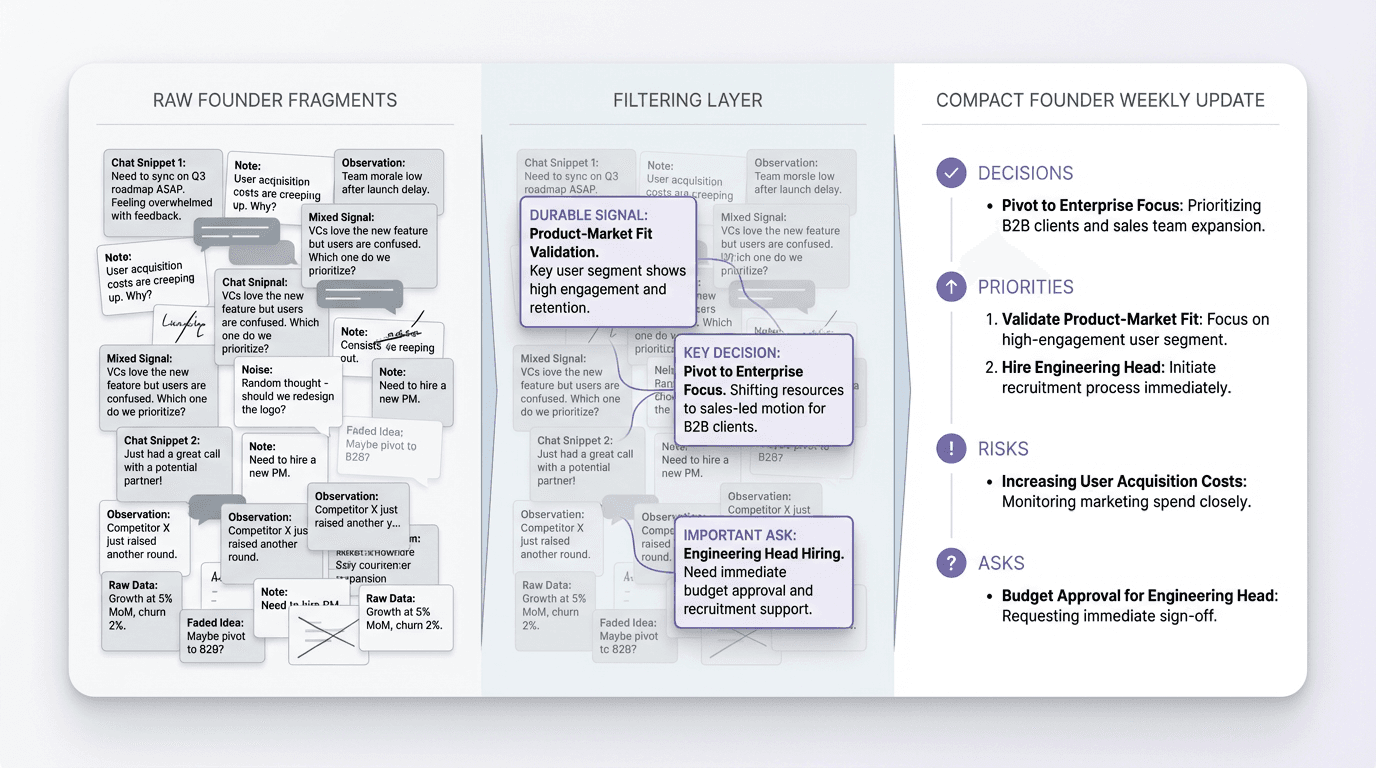
The best founder updates separate signal from residue
Founders generate a lot of residue.
Quick replies. Passing thoughts. Half-formed reactions. Context that is useful in the moment but not durable enough to share as-is.
The weekly version only needs the activity that helps the team understand what changed.
A strong founder weekly update template helps make that cut.
It asks:
- What did I learn that changes how the team should think?
- What decision became clearer?
- What deserves coordinated attention next?
- What can stay as local context and does not need to travel?
That last question matters more than people think. A founder update gets stronger when it does not try to carry the full week. It should carry the parts of the week that improve team judgment.
Founder input appears between meetings, so the workflow should meet it there
This selection makes founder weekly updates harder than their length suggests.
The material does not arrive at a desk in neat sequence. It appears while switching contexts.
A thought after a customer meeting may start on the phone. A line from something you read may matter only after it connects with a product concern from earlier that day. The useful questions are often clearer than the finished wording at that moment.
That means the workflow should not assume all founder thinking begins when the weekly document opens. The better workflow is:
- capture judgments when they appear
- place them roughly into recurring slots
- answer the questions that complete the brief and review one aligned weekly version
FormaLM helps founder thinking arrive as a finished, usable document on iPhone or on the web.
Keep the update directional, not exhaustive
One of the easiest mistakes is turning the founder weekly update into an attempt to cover everything.
That usually weakens the document.
The team does not need every observation. They need a directional version of the week. What became more true. What matters more now. What the founder wants the team to interpret differently.
A strong founder weekly update stays selective and sharpens shared judgment while the week is current.
In practice, this means a shorter update often performs better than a broader one. If a point does not change alignment, priority, or execution, it probably does not belong.
When a shorter founder weekly update template is the better choice
Some teams already have strong day-to-day visibility.
In those cases, the founder update can get even lighter:
That version works well when:
- the team already knows the operating details
- the main need is interpretive clarity
- the founder wants to reduce repeated chat explanation
- the company moves fast enough that shorter weekly alignment is more useful than fuller recap
The point is not choosing the shortest possible format. It is choosing the smallest format that still carries judgment cleanly.
A founder weekly update template works best when it turns private thinking into shared direction
A founder weekly update template gives private thinking a reliable way to travel. It turns chats, quick notes, reading, decisions, and moments of conviction into a compact version the team can align around.
FormaLM provides the repeatable structure needed to move that rough signal into a clear, usable update.